
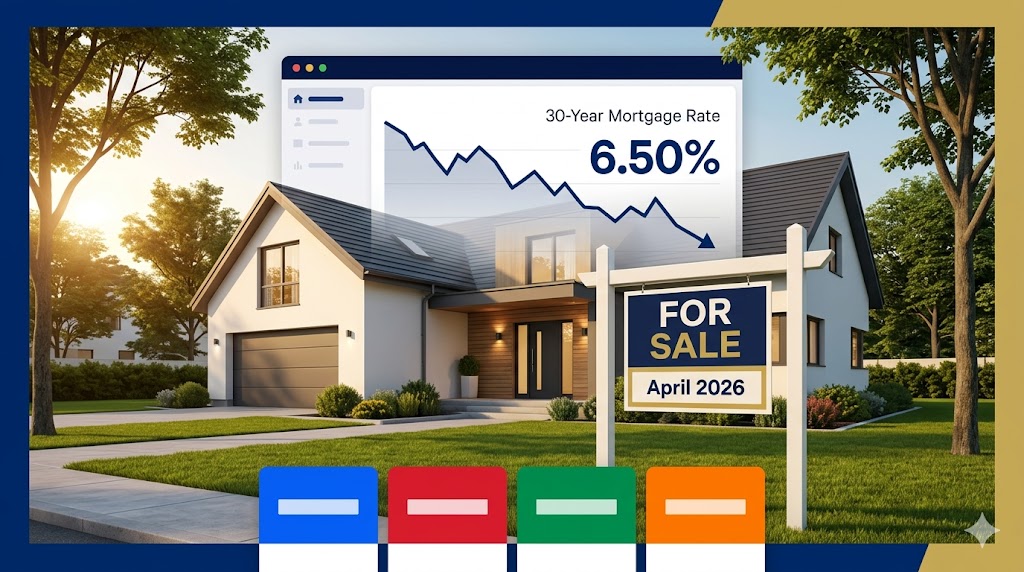
Mortgage rates in April 2026 have reached a pivotal inflection point. After climbing to their highest levels since mid-2025 in late March — driven by geopolitical tensions and inflation fears — the 30-year fixed mortgage rate has pulled back to 6.50% (Bankrate national average) and 6.23% APR (NerdWallet/Zillow) as of April 7, 2026. That’s the moment when millions of Americans start asking: “Should I buy now or wait for lower rates?” and “Which lender will give me the best deal?”
This guide answers both questions with data verified from more than 20 authoritative sources — Bankrate, NerdWallet, Investopedia, CNBC Select, Realtor.com, The Mortgage Reports, LendingTree, CBS News, the CFPB, and direct lender websites. We break down every major loan type, compare the four most-searched lenders, show you exactly how to secure a lower rate, and tell you when refinancing actually makes mathematical sense in 2026.
At-a-Glance: Current Mortgage Rates — April 7, 2026
| Loan Type | Bankrate Avg Rate | NerdWallet/Zillow APR | Change vs. Last Week | Monthly Payment per $100K |
|---|---|---|---|---|
| 30-Year Fixed | 6.50% | 6.23% | ▼ −0.11% | $75.85 |
| 15-Year Fixed | 5.83% | N/A | ▼ −0.08% | $100.16 |
| 5/1 ARM (initial period) | 5.75% | N/A | ▲ +0.02% | $70.03 |
| 30-Year Jumbo | 6.58% | N/A | ▼ −0.10% | ~$79 est. |
| 30-Year Fixed Refinance | 6.65% | N/A | ▼ −0.15% | $70.03 |
| 30-Year FHA (Rocket) | 5.99% APR | N/A | N/A | Est. per lender |
| 30-Year VA (est.) | 5.25%–6.30% | N/A | N/A | Est. per lender |
Sources: Bankrate (April 7, 2026); NerdWallet/Zillow (April 7, 2026); Rocket Mortgage; USMilitary.org VA Loan Rates. Rates change daily. Always verify current rates directly with lenders before making decisions.
Methodology: How We Evaluated and Compared Mortgage Lenders
| Criterion | Weight | How We Measured It |
|---|---|---|
| Published rates & APR transparency | 25% | Whether lender publishes rates online daily (not just ZIP-code locked behind a form); national average vs. top-offer spread; APR disclosure accuracy |
| Product range | 20% | Availability of conventional, FHA, VA, USDA, jumbo, ARM, and refinance products; loan amounts; term options |
| Fees & closing costs | 20% | Origination fees; discount points required to hit advertised rate; lender credits available; APR vs. rate spread as a proxy for fee load |
| Customer experience & digital tools | 15% | Online application; preapproval speed; mobile app; document upload; closing timeline (industry benchmark: 30–45 days) |
| Third-party ratings | 10% | Bankrate Score; NerdWallet lender rating; J.D. Power mortgage satisfaction study; CFPB complaint database |
| Approval accessibility | 10% | Minimum credit score; minimum down payment; options for first-time buyers, military, or rural borrowers |
All rate comparisons use publicly available data from lender websites and independent aggregators. Because Chase, Wells Fargo, and Bank of America require a ZIP code to display personalized rates, we cross-referenced their published rate ranges with Bankrate’s lender rate tables and The Mortgage Reports’ lender reviews as of April 2026.
Section 1: The April 2026 Mortgage Rate Landscape — Why Rates Are Where They Are
Mortgage rates ended March 2026 near their highest levels since mid-2025, per Bankrate. The primary driver: geopolitical uncertainty from the Iran conflict and persistent inflation fears pushed bond yields — and therefore mortgage rates — sharply higher. By early April, the narrative shifted: fears of demand destruction (if energy and food prices slow consumer spending enough, the Fed may cut rates to support the economy) began to pull rates back down.
NerdWallet Senior Economist Elizabeth Renter explained: “Throughout March, geopolitical tensions pushed up mortgage interest rates. April has bond yields ebbing and rates starting to soften — but it’s not because inflation worries were unfounded.”
Key data points shaping April 2026 rates:
- March Jobs Report (April 3, 2026): +178,000 jobs vs. +60,000 projected — strong, but reflecting pre-conflict conditions. May employment data (released in May) will be the first true gauge of conflict impact.
- CPI & PCE reports: March CPI (scheduled April 2026) will be the first data capturing the full geopolitical environment. A hot print could reverse the recent rate pullback immediately.
- Federal Reserve: No rate cut expected at the April/May 2026 meeting. “Any hopes for a spring rate cut have already been extinguished,” per NerdWallet.
Historical context: The 30-year fixed averaged 6.18% in January–February 2026 (below the current 6.50%) and hovered above 7% during the same period in 2025. Bankrate’s full-year 2026 average forecast is 6.1%, with a possible low of 5.7%. The trend is downward, but volatile.
Section 2: Types of Mortgage Loans — Which One Is Right for You?
30-Year Fixed-Rate Mortgage — The American Standard
The most popular U.S. mortgage product. Current average: 6.50% (Bankrate, April 7, 2026). Monthly cost: $75.85 per $100,000 borrowed — roughly $2,028/month on a $400,000 loan (before taxes and insurance). Benefits: maximum payment stability, lower monthly payment vs. shorter terms, flexibility to pay extra without penalty. Trade-off: slower equity buildup and significantly more total interest vs. a 15-year.
Best for: First-time buyers, buyers who need to maximize monthly cash flow, and anyone planning to stay 10+ years who values payment certainty.
15-Year Fixed-Rate Mortgage — Pay Less Interest, Build Equity Faster
Current average: 5.83% (Bankrate) — 67 basis points below the 30-year. Monthly cost: $100.16 per $100,000 borrowed (about $32 more per $100K than the 30-year). The interest savings are extraordinary:
| Metric | 30-Year at 6.50% | 15-Year at 5.83% |
|---|---|---|
| Monthly P&I payment | $2,213 | $2,930 |
| Total payments over loan term | $796,680 | $527,400 |
| Total interest paid | $446,680 | $177,400 |
| Interest savings (15-yr vs. 30-yr) | — | ≈ $269,000 |
| Equity at year 10 | ~$62,000 principal paid | ~$172,000 principal paid |
Estimates calculated using standard amortization at rates current as of April 7, 2026 per Bankrate. Actual payments vary by lender, taxes, insurance, and fees. Use a mortgage calculator for your specific scenario.
Best for: Buyers who can absorb the higher monthly payment; homeowners approaching retirement who want to eliminate the mortgage before stopping work; strong candidates for refinancing from a 30-year when rates fall.
5/1 Adjustable-Rate Mortgage (ARM) — Lower Rate, Defined Risk
Current average: 5.75% (Bankrate) — 75 basis points below the 30-year fixed. Fixed for 5 years, then adjusts annually based on a market index. Monthly savings vs. 30-year: approximately $70.03 per $100,000 in the initial fixed period. ARM caps typically limit increases to 2% per adjustment and 5–6% lifetime above the initial rate. As Bankrate notes, “rates could be materially higher when the loan first adjusts.”
Best for: Buyers who plan to sell or refinance before year 6, or who need a lower initial payment to qualify. Avoid if you plan to stay long-term and can’t absorb a potential rate spike at adjustment.
Jumbo Mortgages — Above the Conforming Loan Limit
The 2026 conforming loan limit is $806,500 in most U.S. counties (higher in New York, Los Angeles, San Francisco). Loans above this are jumbo — held on lenders’ own books, not sold to Fannie/Freddie. Current average: 6.58% (Bankrate). Stricter requirements: 700–720+ credit score, 10–20% down, 6–12 months reserves, DTI typically below 43%. If you’re buying high-value property in a major metro, explore our Ultimate Guide to Commercial Real Estate Investing in 2026.
Section 3: Government-Backed Mortgage Options — FHA, VA, and USDA
For buyers who don’t have a 20% down payment or a perfect credit score, government-backed loans offer competitive rates with more accessible qualification standards. Here’s a breakdown of all three major programs.
FHA Loans — Backed by the Federal Housing Administration
Down payment: 3.5% (580+ credit score) or 10% (500–579). Rocket Mortgage 30-year FHA rate: 5.99% APR (April 7, 2026). FHA loans require an upfront MIP of 1.75% of the loan (can roll into loan) plus annual MIP of 0.55%–0.85% monthly. Key limitation: FHA MIP does not cancel at 80% LTV like conventional PMI — it persists for the life of the loan if you put down less than 10%. Loan limits: $498,257 in most counties. DTI flexibility: up to 57% in some cases. Best for: First-time buyers with sub-740 scores or limited down payment.
VA Loans — The Best Mortgage Product for Eligible Borrowers
Available to veterans, active-duty service members, and surviving spouses. VA rates: 5.25%–6.30% (30-year, 2026) per USMilitary.org — typically 0.25%–0.50% below comparable conventional rates. Key advantages: 0% down payment, no monthly mortgage insurance (saves $100–$300/month), VA caps on lender closing costs, no prepayment penalty. A VA Funding Fee (1.25%–3.3% of loan, financeable) replaces PMI. Rocket Mortgage VA rate: 5.99% APR. Best for: Any eligible veteran or active-duty member — almost always superior to conventional financing.
USDA Loans — Zero Down for Rural and Suburban Buyers
Backed by the U.S. Department of Agriculture. 0% down required, 640+ credit score, income limits at 115% of area median income, property must be in a USDA-eligible area (more suburban areas qualify than most buyers realize). Rates typically below FHA and comparable to VA, per The Mortgage Reports. Best for: Eligible suburban/rural buyers meeting income limits who don’t have VA eligibility.
Government Loan Comparison at a Glance
| Loan Type | Down Payment | Min. Credit Score | Mortgage Insurance | Income Limits | Property Location |
|---|---|---|---|---|---|
| FHA | 3.5% | 580 (3.5% down) / 500 (10% down) | Yes — MIP for life (if <10% down) | None | Anywhere in U.S. |
| VA | 0% | ~620 (lender-set, not VA-set) | No — VA Funding Fee only | None | Anywhere in U.S. |
| USDA | 0% | 640 | Yes — guarantee fee + annual fee | 115% of area median income | Eligible rural/suburban only |
| Conventional | 3%–20%+ | 620 minimum (best rates: 760+) | PMI if <20% down (removable at 80% LTV) | None (but DTI limits apply) | Anywhere in U.S. |
Sources: The Advantage Lending; USMilitary.org; The Mortgage Reports; RefiGuide.
Section 4: Top Lender Comparison — Chase vs. Wells Fargo vs. Rocket Mortgage vs. Bank of America
Not all mortgage lenders are created equal. Even a 0.25% difference in rate on a $400,000 loan over 30 years amounts to roughly $19,000 in total interest. Here is how the four most-searched mortgage lenders in April 2026 stack up against each other.
Chase Mortgage
One of the largest U.S. mortgage originators. Chase requires borrowers to enter their ZIP code to see rates (no public national rate published), but updates daily Monday–Friday. Key products: Conventional (fixed and ARM), FHA, VA, DreaMaker® (3% down with reduced PMI costs for qualifying buyers), and jumbo. Homebuyer Grant: Up to $7,500 in closing cost assistance in select markets. Strengths: Thousands of physical branches, strong digital tools, and prequalification without a hard pull. Limitation: Less rate transparency than Wells Fargo or Rocket before you begin the application. Chase provides public guidance on ways to reduce your mortgage rate. Best for: Existing Chase clients (rate discounts may apply for Priority/Private Client members); buyers who prefer in-person banking.
Wells Fargo Mortgage
Bankrate Score: 4.9/5 — one of the highest for any major U.S. bank. Wells Fargo is notable for publishing its rates publicly online (unlike Chase) and for its 5,600+ branch network. Products: Conventional, FHA, VA, jumbo, yourFirst Mortgage® (3% down). Down payment assistance: Up to $10,000 in select markets. Non-traditional credit accepted (rent, utilities, phone payments). Verify current rates at wellsfargo.com/mortgage/rates. Limitation: Mixed J.D. Power customer satisfaction scores. Best for: Rate-comparison shoppers, first-time buyers qualifying for assistance programs, borrowers with non-traditional credit histories.
Rocket Mortgage
The largest U.S. mortgage lender by volume and the pioneer of fully digital mortgage applications. Current rates (April 7, 2026): 30-year conventional 6.75% APR · 15-year 5.99% APR · FHA 5.99% APR · VA 5.99% APR · Jumbo 5.875% APR. Key differentiators: 15–20 minute digital application; Verified Approval™ (full credit/income/asset verification upfront — stronger than standard preapproval for competitive offers); RateShield® Approval (90-day rate lock while house hunting — vs. the standard 30–60 days). Rating: 4.4–4.5/5 (NerdWallet, The Mortgage Reports). Limitation: Rocket’s advertised 30-year APR (6.75%) is 25 basis points above Bankrate’s national average (6.50%) — borrowers with strong credit profiles may find better rates at local banks, credit unions, or through a mortgage broker. No physical branches; no USDA loans; origination fees 0.5%–1.0% (above average). Best for: Digital-first buyers who need a fast, strong preapproval and value the 90-day rate lock.
Bank of America Mortgage
Rating: 4.3/5 (The Mortgage Reports, 2026). Notable products: Conventional, FHA, VA, Jumbo, and the Affordable Loan Solution® (3% down, no PMI for income-eligible buyers in qualifying census tracts). Down payment assistance: Up to $10,000 (select markets); America’s Home Grant®: up to $7,500 in closing cost credits. Publishes rates daily online. Integration with existing BofA accounts streamlines the application. Limitation: BofA rates have historically run slightly above national averages; 2024 HMDA data showed a rate spread of 1.19 points (meaning total borrowing cost is higher than some peers). Best rates require 740+ credit score. Mixed customer service reviews. Best for: Existing BofA customers who qualify for Preferred Rewards rate discounts; income-eligible first-time buyers targeting the Affordable Loan Solution® or grant programs.
Side-by-Side Lender Scorecard
| Factor | Chase | Wells Fargo | Rocket Mortgage | Bank of America |
|---|---|---|---|---|
| Rates online? | No (ZIP required) | ✅ Yes | ✅ Yes | ✅ Yes |
| 30-yr APR (Apr 7, 2026) | ZIP-dependent | Below national avg | 6.75% (above avg) | At/above national avg |
| Signature product | DreaMaker® 3% down | yourFirst Mortgage® | Verified Approval™; 90-day lock | Affordable Loan Solution® |
| Down payment help | Up to $7,500 | Up to $10,000 | 1%–3% options | Up to $10,000 + $7,500 grant |
| Branches | Thousands | 5,600+ | None (digital only) | 4,000+ |
| Rating 2026 | N/A | 4.9/5 Bankrate | 4.4–4.5/5 NerdWallet | 4.3/5 Mortgage Reports |
| Best for | Existing Chase clients | Rate shoppers; first-timers | Speed & digital; 90-day lock | BofA clients; grant eligibility |
Sources: Bankrate · The Mortgage Reports (Rocket) · The Mortgage Reports (BofA) · NerdWallet · LendingTree. April 2026.
Section 5: How Mortgage Rates Are Actually Determined
The most persistent mortgage myth: the Federal Reserve sets mortgage rates. It does not — at least not directly.
The real driver: the 10-year U.S. Treasury yield. The 30-year mortgage rate typically trades at a 1.5–2.5 percentage point spread above the 10-year Treasury. When bond investors sell Treasuries (pushing yields up), mortgage rates rise. When they buy (pushing yields down), rates fall. This is why rates moved sharply in March 2026 — geopolitical fears sent investors out of bonds, not directly because of Fed action.
The Fed’s indirect role: The Fed controls the overnight federal funds rate, which shapes short-term borrowing costs and inflation expectations. Fed rate cuts reduce inflationary pressure on bonds (good for mortgage rates). Quantitative easing — buying mortgage-backed securities — directly compresses mortgage spreads. At April 2026’s meeting, no cut is expected; fed funds rate is projected at 3.1% by year-end 2026 per MortgageMate.
Borrower-controlled factors that determine your personal rate:
- Credit score: 760+ FICO unlocks best rates. Going from 680→740 saves ~$86/month ($31,000+ over 30 years) on a $400,000 loan per RefiGuide
- Loan-to-value (LTV): 80% LTV gets better pricing than 90–95%; 20% down eliminates PMI entirely
- DTI (debt-to-income ratio): Lenders prefer below 43%; lower is always better
- Property type: Single-family primary residence = best rates; investment properties add 0.5%–0.75%
- Loan type & term: VA < conventional; 15-year < 30-year
- Geographic location: State foreclosure laws, local market competition, and taxes create rate variation
Section 6: How to Get the Best Mortgage Rate in April 2026
These five steps are validated by Bankrate, Norada Real Estate, The Mortgage Reports, and RefiGuide:
1. Maximize your credit score before applying. Aim for 760+ FICO. In the 3–6 months before applying: check and dispute errors at AnnualCreditReport.com, pay revolving balances below 10% utilization, make all payments on time (35% of FICO), avoid opening new accounts or closing old ones. Per Norada Real Estate, improving from 680→740 saves $86/month on a $400K loan over the loan’s life.
2. Build your down payment to 20%+. Reaching 20% down eliminates PMI and improves your rate (moving from 90% to 80% LTV saves ~0.25%). While saving, maximize earnings with a high-yield savings account — see our Best High-Yield Savings Accounts 2026 guide.
3. Shop at least 3–5 lenders. Per The Mortgage Reports, 5 quotes saves $1,200+ vs. taking the first offer. All mortgage applications within a 14-day window count as one inquiry — use this window aggressively. Compare: one national bank, one online lender, one local credit union or mortgage broker. Always compare APR, not just interest rate — APR includes fees and shows the true cost.
4. Reduce your DTI before applying. Pay down auto loans, personal loans, student debt, or credit card balances. DTI = total monthly debt payments ÷ gross monthly income. Target: below 43% (FHA may allow up to 57%). Lower DTI improves both rate and borrowing capacity.
5. Lock your rate promptly. Once you have an offer you’re comfortable with, lock it. Per Bankrate: “Given how unpredictable the economy and mortgage market is, locking in your mortgage rate provides some degree of certainty.” Ask about: lock duration (standard 30–60 days; Rocket offers 90 via RateShield®), lock fees, and whether a float-down option is available (lets you take a lower rate if rates drop during the lock period).
Section 7: Mortgage Points — Should You Buy Down Your Rate?
One discount point costs 1% of your loan amount and typically reduces your rate by 0.25% (range: 0.125%–0.375% depending on lender and market). Key question: does your break-even timeline match how long you’ll stay?
Break-even calculation (verified via NerdWallet’s points calculator):
| Scenario | No Points | 1 Point ($4,000) | 2 Points ($8,000) |
|---|---|---|---|
| Loan amount | $400,000 | $400,000 | $400,000 |
| Interest rate | 6.50% | 6.25% | 6.00% |
| Monthly P&I payment | $2,528 | $2,463 | $2,398 |
| Monthly savings vs. no points | — | $65/month | $130/month |
| Cost of points | $0 | $4,000 | $8,000 |
| Break-even point | — | 61 months (~5.1 yrs) | 62 months (~5.2 yrs) |
| Total savings at year 10 (after cost) | $0 | ~$3,800 | ~$7,600 |
| Total savings at year 30 (after cost) | $0 | ~$19,400 | ~$38,800 |
Estimates via standard amortization at April 7, 2026 rates. Break-even = point cost ÷ monthly savings. Sources: NerdWallet; Ratebeat. Always model your specific loan before paying points.
Buy points when: You plan to stay past break-even (~5+ years), won’t refinance soon, and have surplus cash beyond down payment + 6 months reserves. Skip points when: You’ll sell or refinance within 3–5 years, the cash is better applied to a higher down payment (to eliminate PMI), or you need reserves for moving/emergency costs.
Section 8: Private Mortgage Insurance (PMI) — What It Is and How to Remove It
PMI is required on conventional loans with less than 20% down. It protects the lender, not you, and costs approximately 0.5%–1.5% of the loan annually — roughly $146–$438/month on a $350,000 loan. Per the CFPB:
- At 80% LTV — submit a written cancellation request (may require a new appraisal)
- At 78% LTV — your lender must cancel automatically (Homeowners Protection Act)
- At loan midpoint — cancels automatically regardless of LTV (e.g., year 15 of a 30-year)
Accelerate PMI removal by making extra principal payments, requesting a new appraisal if home values have risen, or refinancing when equity reaches 20%+. Critical FHA distinction: FHA MIP does not cancel at 80% LTV — it persists for the full loan term (if <10% down), making the eventual switch to conventional financing (via refinance) an important planning consideration for FHA borrowers.
Section 9: When to Refinance in 2026 — The Break-Even Framework
Current 30-year refinance rate: 6.65% (Bankrate, April 7, 2026). Refinancing makes sense primarily for homeowners who locked above 7.5%–8% during the 2023–2024 rate peaks. The only framework that matters:
Break-Even Point = Total Closing Costs ÷ Monthly Payment Savings
If this number of months is less than how long you’ll stay in the home, refinancing is worth it.
Example: $300,000 mortgage at 7.25% (2023) → refinance to 6.50%: Old payment $2,047 → new payment $1,896 → saves $151/month. Closing costs ~$7,500 (2.5%). Break-even: $7,500 ÷ $151 = 49.7 months (~4.2 years). Stay 5+ years: refinance saves money. Move in 2–3 years: it doesn’t.
Types of refinancing in 2026:
- Rate-and-term: New loan, better rate or term. Closing costs: 2%–5%. Most common.
- Cash-out: Borrow more than you owe, take difference as cash (home improvements, debt payoff). Rate ~0.25%–0.375% higher than rate-and-term. Most lenders cap at 80% LTV.
- Cash-in: Bring cash to closing to lower balance → better rate or remove PMI.
- Streamline (FHA/VA): Reduced documentation — contact your current servicer.
No-closing-cost refinance: Fees are either rolled into the loan (higher balance) or absorbed via a higher rate (lender credit of ~0.125%–0.25% above market). You pay eventually — it just takes longer to break even. Best if you plan to refinance again in 2–3 years (targeting sub-6% rates forecast for H2 2026). For real estate wealth-building strategy, see our Ultimate Guide to Commercial Real Estate Investing in 2026.
Section 10: Is Now a Good Time to Buy? — The Honest Data
Per Realtor.com’s 2026 National Housing Forecast and AEI Housing Market Indicators:
- Home prices: +2.2% nationally in 2026 (real/inflation-adjusted prices declining for 2nd year — affordability improving)
- For-sale inventory: +8.9% YoY (more choices; the West +12.2%, Midwest +10.3%)
- Existing-home sales: 4.13 million in 2026 (up from near 30-year lows in 2025)
- Affordability milestone: typical mortgage payment = 29.3% of median income — first time below 30% since 2022
- Lock-in effect: ~4 in 5 homeowners with mortgages have rates below 6%, limiting how many existing homes come to market
Case for buying now: Prices rise 2.2% in 2026 — waiting costs you in purchase price; inventory is improving (more negotiating power); the affordability ratio is at a 4-year best; you can refinance when rates fall but can’t buy at today’s prices later.
Case for waiting: Rates forecast to fall to 5.7%–6.0% in H2 2026; if your credit or down payment is still improving, 6–12 more months of preparation could unlock materially better terms; high-inventory markets offer less urgency.
NerdWallet’s guidance is direct: “If you can comfortably afford a mortgage now, don’t get too hung up on whether you could be missing out on lower rates later; you can refinance down the road. Focus on getting preapproved, comparing lender offers, and understanding what monthly payment works for your budget.”
Section 11: 2026 Mortgage Rate Forecast — What to Expect the Rest of the Year
Multiple authoritative forecasters project a modest decline in mortgage rates through the remainder of 2026, but they agree the pace will be slow and the path volatile:
| Forecaster | Average 2026 Rate Projection | Year-End 2026 Target | Potential Low | Source |
|---|---|---|---|---|
| Bankrate | ~6.1% full-year average | Not specified | ~5.7% | bankrate.com |
| Investopedia | 5.90%–6.30% by year-end | ~6.0% | Briefly below 6% | investopedia.com |
| MortgageMate | 6.5% Q1 → 5.9% Q3 → 5.8% Q4 | 5.8% | 5.5%–5.8% | mortgagemate.app |
| Realtor.com | 6.3% full-year average | Not specified | Not specified | realtor.com |
| CNBC Select | High 5%–low 6% range | ~6.0% | Possibly sub-6% briefly | cnbc.com |
Sources: Bankrate 2026 Forecast; Investopedia; MortgageMate; Realtor.com; CNBC Select. Forecasts are estimates, not guarantees.
Key factors that could accelerate the decline:
- Inflation moderating toward the Fed’s 2% target faster than expected
- Geopolitical tensions easing (lower energy prices → lower inflation → lower yields)
- Economic slowdown that forces the Fed to cut rates more aggressively
Key factors that could delay the decline (or push rates back up):
- Inflation re-accelerating due to energy prices, tariffs, or supply shocks
- Stronger-than-expected economic growth (reduces bond demand, pushes yields higher)
- The Fed maintaining a “higher for longer” stance longer than markets anticipate
- Geopolitical escalation driving a flight to safety (which actually lowers Treasury yields) or inflation spikes
Investopedia notes that while mortgage rates could dip below 6% in 2026, “the window may be brief” — suggesting that borrowers who see a window of sub-6% rates should be prepared to move quickly.
Section 12: Find Licensed Mortgage and Real Estate Professionals Near You
Working with a qualified local mortgage professional or real estate agent can mean the difference between getting a mediocre rate and an exceptional one. Our directory lists vetted real estate and financial services businesses across the United States:
- Browse Loan and Mortgage Professionals in our directory — including commercial financing specialists, consumer lenders, and mortgage brokers
- Find Financial Planning and Advisory Services near you — for holistic guidance on whether buying vs. renting is right for your situation
- Explore Real Estate Professionals in your market — for buyer’s agent representation, market comparables, and negotiation expertise
Related reading from our editorial team:
- The Ultimate Guide to Commercial Real Estate Investing in 2026
- Best High-Yield Savings Accounts 2026: Rates Above 5% (SoFi vs Marcus vs Ally)
- Best Brokerage Accounts 2026: Fidelity vs Schwab vs Vanguard
- Commercial Property Insurance Cost in New York 2026
Frequently Asked Questions — Mortgage Rates April 2026
What is the average 30-year mortgage rate in April 2026?
As of April 7, 2026: 6.50% per Bankrate’s national average and 6.23% APR per NerdWallet/Zillow. Your personal rate will vary based on credit score, LTV, loan type, lender, and location.
What is a “good” mortgage rate in 2026?
For a well-qualified borrower (760+ FICO, 20% down, single-family primary residence): 6.25%–6.50% on a 30-year fixed is competitive in April 2026. Below 6.25% is excellent. Above 6.75% for a qualified borrower suggests room to improve via credit, lender shopping, or higher down payment.
Will mortgage rates drop in 2026?
Most forecasters project a decline to 6.0%–6.3% average for 2026, with possible brief dips below 6% in H2 2026 (Bankrate, Investopedia, MortgageMate). No Fed rate cut is expected at the April/May 2026 meeting. Geopolitical events and inflation data can shift the trajectory rapidly.
Should I choose an ARM or fixed-rate mortgage in 2026?
If you’ll own the home 7+ years, a 30-year fixed (6.50%) provides certainty. If you plan to sell or refinance within 5–7 years, a 5/1 ARM (5.75%) saves ~$75/month per $100K borrowed during the initial fixed period — with the risk of higher payments when the ARM adjusts at year 6.
What credit score do I need for the best mortgage rate?
760–780+ FICO for the best conventional rates. 700–759 qualifies for good (not best) rates. Below 620, FHA loans (580+ minimum) become the primary option.
What is the difference between interest rate and APR?
Interest rate = base cost of borrowing. APR = interest rate + lender fees, points, and origination charges. APR is always higher (unless zero fees) and is the correct metric for comparing lenders — always compare APR, not just rate.
Can I refinance if I already have a rate below 6%?
Not beneficially at today’s rates (6.50%–6.65% for refinance). Refinancing makes sense when today’s rate is at least 0.5%–0.75% lower than your current rate, and you’ll remain long enough to break even on closing costs. Homeowners with 7%+ rates from 2023–2024 are the primary refinance candidates in April 2026.
How do I remove PMI from my mortgage?
Request PMI cancellation in writing when you reach 80% LTV; your lender must cancel automatically at 78% LTV per the Homeowners Protection Act (CFPB). Accelerate by making extra principal payments, getting a new appraisal (if home appreciated), or refinancing. Note: FHA MIP does not follow these rules — it persists for the loan’s life (if <10% down).
Primary sources consulted for this article: Bankrate (April 7, 2026) · NerdWallet/Zillow (April 7, 2026) · Rocket Mortgage rates · Bankrate — Wells Fargo review · The Mortgage Reports — BofA · The Mortgage Reports — Rocket · NerdWallet — Rocket review · LendingTree — BofA review · Investopedia — 2026 forecast · CNBC Select — rate outlook · CBS News — Fed & mortgages · MortgageMate forecast · Realtor.com 2026 housing forecast · AEI Housing Market Indicators · CFPB — PMI cancellation · Redfin — remove PMI · NerdWallet — mortgage points · Ratebeat — points guide · The Advantage Lending — refinance guide · Norada Real Estate — rate tips · USMilitary.org — VA rates · RefiGuide — first-time buyer guide · The Mortgage Reports — rate shopping · LendingTree — mortgage rates April 2026

Author: Iovanny Olguín Ávila
Computer Systems Engineer with an MSc in Computer Science. I apply quantitative analysis and data-driven methodologies to evaluate financial instruments, investment vehicles, and emerging technologies. My technical background allows me to cut through marketing language and analyze the actual mechanics of financial products — from HELOC structures to Medicare Advantage plan design to business credit card reward algorithms.