We independently evaluate products. Data as of February 2026. Not investment advice.
74% of supply chain leaders expect profit growth by adopting circular strategies. Collaborative supply chains can lower operational costs by 15–25%. 73% of consumers prefer sustainable brands and will pay premiums. EU Packaging and Packaging Waste Regulation (PPWR) takes effect August 2026. This guide covers how US businesses are implementing circular supply chains and attracting ESG-focused investors.
| Strategy | Benefit | Implementation | ROI Driver |
|---|---|---|---|
| Design for reuse | Reduce waste; extend life | Modular; recyclable materials | Lower input costs |
| Reverse logistics | Recapture value | Returns; refurbishment | Revenue from resale |
| Supplier collaboration | Transparency | Blockchain; audits | 15–25% cost reduction |
| ESG reporting | Investor confidence | CSRD; DPP | Lower cost of capital |
Methodology: How We Evaluated Circular Economy Strategies
We assessed: (1) Waste reduction and recycling—closed-loop systems; (2) ESG and investor appeal—reporting, ratings; (3) Cost and ROI—documented savings; (4) Regulatory alignment—compliance with emerging rules. Data from corporate sustainability reports and consulting studies.
From Linear to Circular
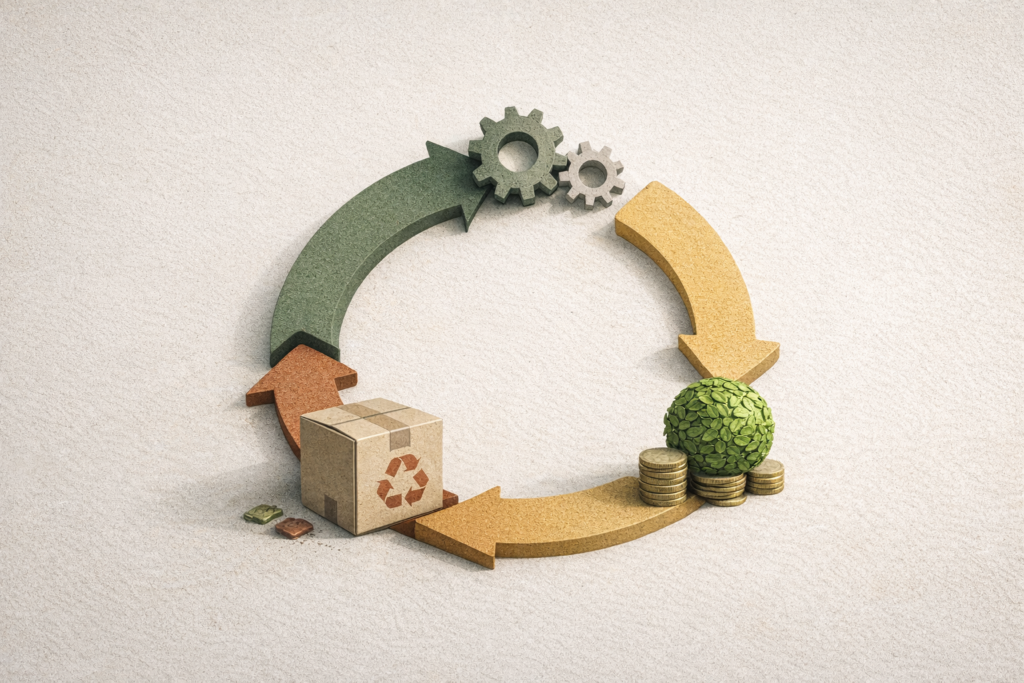
Companies are shifting from “take-make-dispose” to reuse, recycle, and reintroduce. Drivers: resource scarcity, volatile input costs, consumer demand, regulation. Studies show 5–15% cost reduction from waste reduction and material reuse.
2026 Regulatory Landscape
PPWR (EU) mandates recyclability; CSRD requires sustainability reporting. Digital Product Passports are coming. US supply chains must align with global standards. EU regulations are driving mandatory disclosure—early adopters have a reporting advantage.
Implementing Circular Supply Chains
Steps: map material flows, design for disassembly, establish take-back programs, partner with recyclers, and track circularity metrics (e.g., recycled content %, waste diverted). Technology (IoT, blockchain) enables traceability.
Implementation Roadmap
Prioritize high-impact areas; design for reuse; establish reverse logistics; leverage technology for traceability; measure via ESG metrics.
Frequently Asked Questions
What is a circular supply chain? One that minimizes waste through reuse, recycling, and closed-loop systems.
Does sustainability improve profits? 74% of supply chain leaders expect profit growth; collaborative chains can cut costs 15–25%.
What is PPWR? EU Packaging and Packaging Waste Regulation—effective August 2026.
Does circular economy improve stock performance? ESG leaders often outperform over the long term; causality is debated, but investor demand is real.
What regulations affect supply chain sustainability? EU CSRD, California climate disclosure, and SEC proposals are expanding reporting requirements.
Bottom Line
Circular strategies can boost ROI and attract ESG capital. Explore ESG funds and supply chain software at SAP, Salesforce. Consult WEF reports and supply chain advisors.

Author: Iovanny Olguín Ávila
Computer Systems Engineer with an MSc in Computer Science. I apply quantitative analysis and data-driven methodologies to evaluate financial instruments, investment vehicles, and emerging technologies. My technical background allows me to cut through marketing language and analyze the actual mechanics of financial products — from HELOC structures to Medicare Advantage plan design to business credit card reward algorithms.