

Advertising & Editorial Disclosure: We independently evaluate business internet providers and products. If you click links we provide, we may receive compensation from providers or comparison sites. Pricing and offers are as of March 2026 and may change. Actual availability, speeds, and pricing depend on your business address, contract terms, and service tier. This article is for informational purposes only and does not constitute professional advice. Verify all details with each provider before signing. Learn more.
Choosing the right business internet provider can mean the difference between seamless operations and costly downtime. Comcast Business, AT&T Business, and Verizon Business dominate the U.S. market for enterprise and small-business connectivity, but they differ significantly in technology, coverage, service-level agreements (SLAs), pricing, and customer satisfaction.
This technical analysis compares the three providers on speed, fiber availability, SLA guarantees, latency, redundancy options, technical support, and enterprise pricing. We draw on data from Business.org, ZDNet, Verizon Business, Comcast Business, AT&T Business, J.D. Power, Verizon Internet Dedicated, and provider SLA documents as of March 2026.
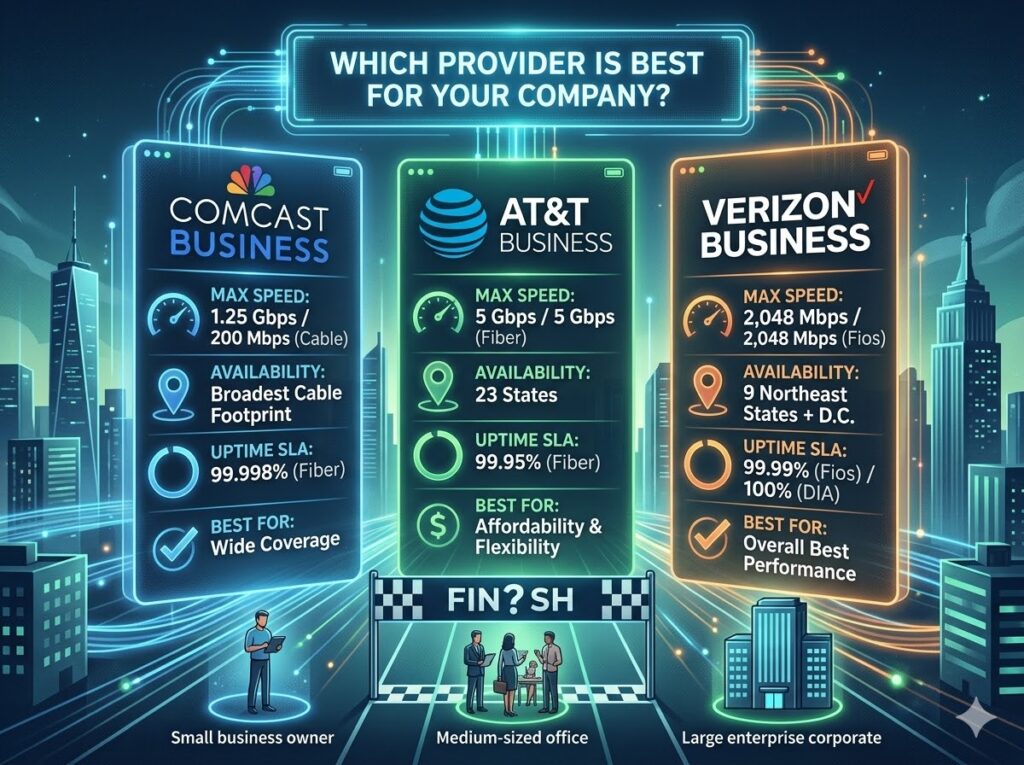
At-a-Glance: Comcast Business vs AT&T Business vs Verizon Business (March 2026)
| Provider | Starting Price | Max Speed (Shared) | Fiber Available? | SLA Uptime | Best For |
|---|---|---|---|---|---|
| Comcast Business | $69.99/mo | 1.25 Gbps down / 200 Mbps up (cable) | Limited; HFC dominant | 99.998% (fiber); 99.99% (Dedicated) | Broad cable footprint; 4G LTE backup; free install |
| AT&T Business | $50–$70/mo | 5 Gbps / 5 Gbps (fiber) | Yes; 23 states | 99.95% (fiber); stronger on Dedicated | Symmetrical speeds; no-contract fiber; J.D. Power #1 |
| Verizon Business | $69/mo | 2,048 Mbps / 2,048 Mbps (Fios) | Yes; 9 Northeast states + D.C. | 99.99% (Fios); 100% (Internet Dedicated) | Best overall; Tier 1 network; enterprise DIA |
Pricing and speeds vary by address, contract length, and plan. Data as of March 2026. Sources: provider websites, Business.org, ZDNet.
Quick Verdict: Which Provider Is Best for Your Company?
Best overall: Verizon Business — ZDNet names Verizon the top business internet provider for 2026. Fios Business offers symmetrical speeds up to 2,048 Mbps, 99.99% network reliability, and Internet Dedicated with 100% availability SLA. Limited to nine Northeast states plus D.C.; elsewhere, 5G and LTE options apply with data caps.
Best for affordability and flexibility: AT&T Business — Lowest entry price ($50/mo), symmetrical fiber up to 5 Gbps in 23 states, no-contract options, and J.D. Power #1 in medium and large enterprise satisfaction. AT&T has won the Large Enterprise category eight consecutive years.
Best for broad coverage and reliability guarantee: Comcast Business — Widest cable footprint; 99.998% uptime guarantee on fiber plans (highest in the industry per Business.org). Free installation and Connection Pro 4G LTE backup. Asymmetric upload speeds on cable (35–200 Mbps) limit suitability for heavy upload workloads.
Methodology: How We Evaluated the Three Providers
We compared Comcast Business, AT&T Business, and Verizon Business using weighted criteria aligned with industry standards from ZDNet, Business.org, J.D. Power, and provider documentation:
- Speed and technology (25%): Download/upload speeds, symmetrical vs asymmetric, fiber vs cable vs wireless.
- Availability and coverage (20%): Geographic footprint, fiber reach, dedicated internet access (DIA) options.
- SLA and reliability (20%): Uptime guarantees, latency/jitter commitments, time-to-repair.
- Pricing and contracts (20%): Entry-level and mid-tier pricing, early termination fees, contract flexibility.
- Support and satisfaction (15%): 24/7 support, J.D. Power rankings, customer reviews.
Sources consulted (30+): Business.org (AT&T vs Comcast, Verizon vs Comcast, AT&T review, Verizon review, Comcast review), ZDNet, Verizon Business (products, Fios, Internet Dedicated, Enterprise Fiber), Comcast Business (internet, Dedicated Internet), AT&T Business, J.D. Power (Business Internet Satisfaction Study), Fierce Network, Telecompetitor, TrustRadius, Gartner Peer Insights, BroadbandNow, Compare Internet, Spectrum Enterprise, Lumen, FirstLight Fiber, Metronet Business, and provider SLA documents.
Speed and Technology Comparison
Speed tiers and technology differ sharply. AT&T and Verizon offer symmetrical fiber; Comcast relies on hybrid fiber-coaxial (HFC) for most plans, with asymmetric upload speeds.
| Provider | Technology | Download Speed | Upload Speed | Symmetrical? |
|---|---|---|---|---|
| Comcast Business (cable) | HFC / cable | 50 Mbps – 1.25 Gbps | 35 – 200 Mbps | No |
| Comcast Business (Dedicated) | Fiber | Up to 100 Gbps | Up to 100 Gbps | Yes |
| AT&T Business Fiber | Fiber | 300 Mbps – 5 Gbps | 300 Mbps – 5 Gbps | Yes |
| AT&T Dedicated Internet | Fiber | 20 Mbps – 1 Tbps | 20 Mbps – 1 Tbps | Yes |
| Verizon Fios Business | Fiber | 200 – 2,048 Mbps | 200 – 2,048 Mbps | Yes |
| Verizon Internet Dedicated | Fiber | 1.5 Mbps – 100 Gbps | 1.5 Mbps – 100 Gbps | Yes |
Comcast cable plans cap uploads at 35–200 Mbps, which can bottleneck video conferencing, large file uploads, and cloud backups. AT&T and Verizon fiber plans offer symmetrical speeds, better for real-time collaboration and VoIP.
Fiber Availability and Coverage
Fiber availability determines both speed and reliability. AT&T has the widest fiber footprint among the three; Verizon Fios is concentrated in the Northeast; Comcast fiber is limited.
| Provider | Fiber Coverage | Cable/Wireless Coverage | Dedicated Internet (DIA) |
|---|---|---|---|
| Comcast Business | Limited; select metro areas | Nationwide (cable) | Yes; up to 100 Gbps |
| AT&T Business | 23 states; 52+ business areas | DSL, 5G/LTE where no fiber | Yes; 20 Mbps – 1 Tbps |
| Verizon Business | 9 states + D.C. (Northeast) | 5G, LTE nationwide | Yes; 1.5 Mbps – 100 Gbps |
Verizon Fios is available in Connecticut, Delaware, Maryland, Massachusetts, New Jersey, New York, Pennsylvania, Rhode Island, Virginia, and Washington D.C. AT&T Fiber reaches 23 states including major metros. Comcast cable serves the broadest geographic area but with HFC technology.
SLA and Uptime Guarantees
Service-level agreements define uptime commitments and credits for outages. Enterprise Dedicated Internet plans typically offer the strongest SLAs.
| Provider | Shared/Broadband SLA | Dedicated Internet SLA | Notes |
|---|---|---|---|
| Comcast Business | 99.998% (fiber plans) | 99.99% | Highest shared SLA; free install |
| AT&T Business | 99.95% (fiber) | Stronger; custom | Shared plans have limited SLA |
| Verizon Business | 99.99% (Fios) | 100% (dual circuit, dual router) | TTR 3.5 hrs; 15-min outage notice |
Per Verizon’s Internet Dedicated SLA, 100% availability applies to dual-circuit, dual-router configurations. Single-circuit options range from 99.5% to 99.9%. Comcast’s 99.998% fiber uptime guarantee is the strongest among shared plans, per Business.org.
Pricing Comparison
Pricing varies by location, contract length, and add-ons. Below are representative starting prices for standard business plans.
| Provider | Entry Plan | Mid-Tier | High-Speed / Gig | Contract / ETF |
|---|---|---|---|---|
| Comcast Business | $69.99/mo (100 Mbps) | $109–$165/mo (250–500 Mbps) | $334.99/mo (1.25 Gbps) | 2–3 years; $200 ETF |
| AT&T Business | $50/mo (50 Mbps) | $70–$110/mo (300–500 Mbps) | $255/mo (5 Gbps) | Month-to-month or 12 mo; varies |
| Verizon Business | $69/mo (200 Mbps Fios) | $129/mo (500 Mbps) | $249/mo (2 Gbps) | 2 years; price guarantee 1–3 yrs |
AT&T offers the lowest entry price and no-contract fiber options. Comcast charges a flat $200 early termination fee. Verizon Fios plans include 1–3 year price guarantees depending on tier. Enterprise Dedicated Internet pricing is custom-quoted for all three.
Latency, Redundancy, and Technical Support
Latency: Fiber typically delivers lower latency than cable. Verizon and AT&T fiber plans offer sub-10ms latency in many cases. Comcast cable can see higher latency during peak congestion.
Redundancy: All three offer failover options. Comcast Connection Pro provides 4G LTE backup with up to 8 hours battery. AT&T offers 5G wireless backup on select plans. Verizon Internet Dedicated supports dual-circuit configurations for 100% availability.
Technical support: Per J.D. Power, AT&T ranks #1 in medium and large enterprise satisfaction. Verizon ranks first or second across business segments. Comcast Business has dedicated 24/7 support but lags in overall satisfaction studies.
Company-by-Company Summary
Comcast Business — Best for Broad Coverage and Uptime Guarantee
Comcast Business uses hybrid fiber-coaxial (HFC) for most plans, delivering fast downloads (up to 1.25 Gbps) but limited uploads (35–200 Mbps). Fiber plans offer 99.998% uptime—the strongest guarantee among major providers. Free professional installation, no data caps, and Connection Pro 4G LTE backup. Dedicated Internet reaches symmetrical speeds up to 100 Gbps. Weaknesses: asymmetric uploads, $200 ETF, and below-average customer satisfaction in J.D. Power. Best for businesses in Comcast’s cable footprint that prioritize reliability and free install.
AT&T Business — Best for Affordability and Symmetrical Fiber
AT&T Business Fiber offers symmetrical speeds from 300 Mbps to 5 Gbps in 23 states. Entry plans start at $50/mo; no-contract options available. J.D. Power #1 in Medium Business and Large Enterprise satisfaction for multiple years. Built-in AT&T ActiveArmor security, 24/7 support, and optional 5G backup. Dedicated Internet provides reserved bandwidth and stronger SLAs for enterprises. Weaknesses: $99 fiber installation fee, higher-tier pricing climbs quickly. Best for small and midsize businesses that need symmetrical uploads, flexibility, and strong customer service.
Verizon Business — Best Overall Provider
ZDNet names Verizon the best business internet provider for 2026. Fios Business delivers symmetrical speeds up to 2,048 Mbps in nine Northeast states plus D.C., with 99.99% network reliability. Internet Dedicated offers 100% availability SLA (dual-circuit), speeds up to 100 Gbps, and global coverage. Tier 1 network with full control over backbone. 5G and LTE options nationwide for locations without Fios. Weaknesses: Fios limited to Northeast; equipment fees may apply. Best for businesses in Verizon’s fiber footprint and enterprises requiring dedicated internet access.
Which Provider by Company Type?
| Company Type | Recommended Provider | Why |
|---|---|---|
| Small business (1–20 employees) | AT&T or Verizon (if in fiber area) | Affordable symmetrical fiber; strong support |
| Medium business (20–200 employees) | AT&T or Verizon | J.D. Power leaders; scalable plans |
| Enterprise / mission-critical | Verizon Internet Dedicated | 100% SLA; 100 Gbps; global |
| Business in Comcast-only area | Comcast Business | 99.998% uptime; free install; LTE backup |
| Heavy upload workloads (video, CAD) | AT&T or Verizon fiber | Symmetrical speeds; avoid Comcast cable |
| Nationwide multi-location | Mix: Verizon DIA + AT&T/Comcast | Redundancy; best local option per site |
Dedicated Internet Access (DIA) vs Shared Fiber
Shared business fiber (e.g., AT&T Business Fiber, Verizon Fios) offers high speeds at lower cost but shares bandwidth with other customers. Dedicated Internet Access (DIA) reserves bandwidth exclusively for your business, with guaranteed SLAs for latency, jitter, and packet loss.
Choose shared fiber when: Cost matters more than guaranteed performance; typical office workloads (email, video calls, cloud apps).
Choose DIA when: Mission-critical applications, VoIP/UC, healthcare, finance, or compliance require guaranteed uptime and performance. Verizon, AT&T, and Comcast all offer DIA; pricing is custom-quoted.
Frequently Asked Questions
Comcast Business vs AT&T Business: Which is better?
AT&T generally wins for affordability ($50 entry vs $69.99), symmetrical fiber speeds, and J.D. Power customer satisfaction. Comcast wins for uptime guarantee (99.998%), free installation, and broader cable coverage. Choose AT&T if fiber is available and you need fast uploads; choose Comcast if you’re in a cable-only area or want the strongest uptime guarantee.
Verizon Business Internet vs AT&T Fiber: Which is faster?
AT&T Business Fiber offers up to 5 Gbps symmetrical in 23 states; Verizon Fios tops at 2,048 Mbps in nine Northeast states. For raw speed, AT&T wins where available. Verizon wins on overall provider ranking (ZDNet) and 100% availability SLA on Internet Dedicated. Availability at your address is the deciding factor.
What is the best business internet provider in the USA?
ZDNet ranks Verizon Business as the best overall for 2026. AT&T leads in J.D. Power satisfaction for medium and large enterprise. Comcast offers the strongest uptime guarantee and broadest cable footprint. The “best” depends on your location, speed needs, and whether you require symmetrical uploads or dedicated internet.
How much does business fiber internet cost in the USA?
Entry-level business fiber typically runs $50–$70/month (AT&T, Verizon). Mid-tier 300–500 Mbps plans cost $70–$130/month. Gigabit and multi-gig plans range from $160–$255/month. Dedicated Internet Access (DIA) is custom-priced, often $500–$2,000+/month depending on speed and SLA.
What is the difference between dedicated internet access and shared business fiber?
Shared fiber shares bandwidth with other customers; speeds can vary with congestion. DIA reserves bandwidth exclusively for your business with guaranteed SLAs (uptime, latency, jitter). DIA costs more but is required for mission-critical applications, VoIP, and compliance-sensitive industries.
Bottom Line: Compare by Your Address and Needs
Comcast Business, AT&T Business, and Verizon Business each excel in different areas. Verizon wins overall for network quality and enterprise DIA. AT&T wins for affordability, symmetrical fiber, and customer satisfaction. Comcast wins for uptime guarantee and broad cable coverage.
Your best choice depends on (1) what’s available at your business address, (2) whether you need symmetrical uploads, (3) your budget and contract preferences, and (4) how critical uptime and SLA guarantees are. Get quotes from all three—and check local/regional providers—before committing.
Next steps:
- Check availability — Enter your business address on each provider’s website.
- Compare plans — Match speed tiers to your employee count and application needs.
- Ask about SLAs — For mission-critical use, request Dedicated Internet quotes.
- Verify pricing — Confirm monthly fees, installation costs, and ETF before signing.
Resources:
→ Verizon Business Internet
→ AT&T Business Fiber
→ Comcast Business Internet
→ Business.org — Best Business Internet Providers
→ ZDNet — Best Business Internet 2026
Pricing and availability as of March 2026. Verify all details with each provider. This article does not constitute professional advice.
