
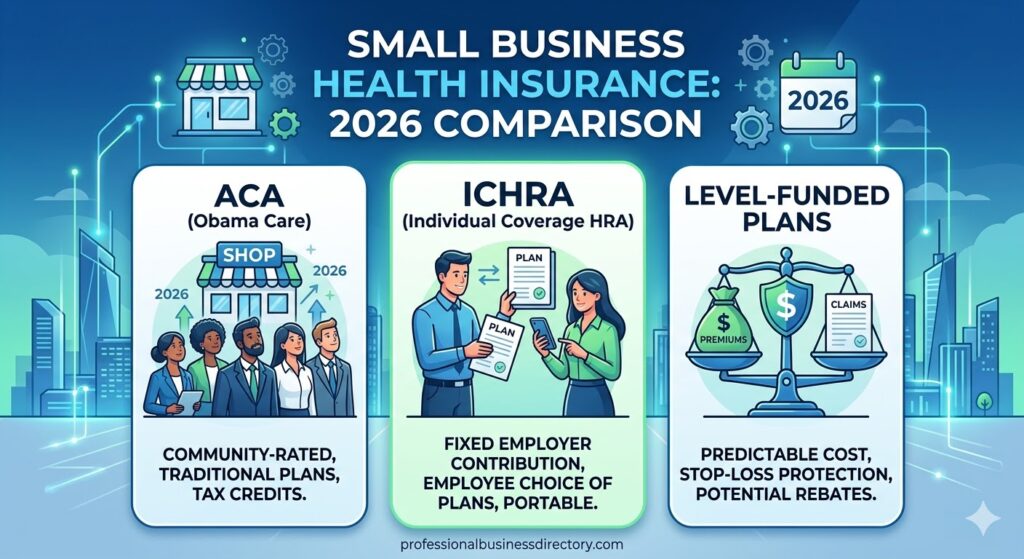

Small business health insurance is one of the most consequential financial decisions a U.S. employer makes — and in 2026, the landscape has never been more complex or more full of opportunity. ACA marketplace premiums rose a median of 11% in 2026, according to the Peterson-KFF Health System Tracker, yet innovative alternatives — individual coverage HRAs (ICHRA), level-funded plans, and qualified small employer HRAs (QSEHRA) — can reduce employer costs by 30–50% versus traditional group coverage while giving employees more choice. Meanwhile, the average employer cost for family coverage reached $26,993 per employee per year in 2026, per HSA for America. For a 10-person team, that is $270,000 annually — a number that demands strategic management.
This guide covers every major health insurance option available to U.S. small businesses in 2026: traditional group plans, SHOP marketplace, level-funded plans, ICHRA, QSEHRA, PEOs, and HSA-compatible strategies. We include real cost data, plan comparisons, a framework for choosing the right model by company size, and expert guidance on compliance with the ACA, IRS, and ERISA. Whether you have 1 employee or 100, this is the definitive resource for small business health benefits in 2026.
At-a-Glance: Small Business Health Insurance Options 2026
| Option | Best For | Employer Cost Control | Employee Choice | Min Employees | Key Compliance |
|---|---|---|---|---|---|
| Traditional Group Plan | 20–100 employees wanting full benefits | Low (fixed premiums) | Low (one plan) | 2 (varies by state) | ACA, ERISA, state mandates |
| SHOP Marketplace | 1–50 employees (ACA-compliant) | Medium | Low–Medium | 1 | ACA SHOP rules |
| Level-Funded Plan | 10–200 employees with healthy workforce | High (stop-loss protection) | Low–Medium | 10 | Self-insured rules, stop-loss |
| ICHRA | Any size; distributed/remote teams | Very High (fixed budget) | Very High (own plan) | 1 | IRS Notice 2019-45, ACA |
| QSEHRA | Under 50 employees; no group plan | High (annual cap) | High | 1 | IRS $6,350/$12,800 caps 2026 |
| PEO (co-employment) | Under 50 wanting large-group rates | Medium | Medium | 1–2 | Co-employer liability |
| HSA-Compatible HDHP | Any size; supplement to above | High (lower premiums) | Medium | 1 | IRS HDHP minimums |
Methodology: How We Evaluated Small Business Health Insurance Options
Our evaluation framework weights seven criteria to produce a composite score for each option:
| Criterion | Weight | What We Measured |
|---|---|---|
| Cost to employer | 25% | Average monthly premium contribution per employee; total annual employer outlay |
| Employee flexibility | 20% | Number of plan choices; ability to keep existing doctors and networks |
| Compliance complexity | 20% | ACA, IRS, ERISA, and state requirements; administrative burden |
| Plan quality / benefits richness | 15% | Network breadth, out-of-pocket caps, preventive care coverage |
| Scalability | 10% | Ease of adding/removing employees; suitable for growth stages |
| Tax efficiency | 10% | Employer deductibility; employee pre-tax contributions; HSA compatibility |
Data sourced from: Peterson-KFF Health System Tracker, Blake Insurance Group, HSA for America, StretchDollar, Health Based Healthcare, IRS guidance, and DOL ERISA regulations. Plan data as of March 2026.
Section 1: ACA Marketplace & SHOP — What Small Businesses Need to Know in 2026
The Small Business Health Options Program (SHOP) is the ACA’s dedicated marketplace for employers with 1–50 full-time equivalent employees (FTEs). SHOP plans are ACA-compliant, meaning they cover all 10 Essential Health Benefits (EHBs), cannot exclude pre-existing conditions, and must meet actuarial value standards (Bronze 60%, Silver 70%, Gold 80%, Platinum 90%). Employers can offer one plan or — in states with “employee choice” — multiple plans at the same metal tier, letting employees choose their preferred network.
2026 ACA Premium Changes by Region
The median ACA premium increase for 2026 is 11% nationally, per the Peterson-KFF Health System Tracker. However, the range is enormous:
| Market / Region | 2026 Premium Change | Context |
|---|---|---|
| Wichita, KS (Gold plan) | +68.3% | Insurer exit and risk pool deterioration |
| Hartford, CT (Gold plan) | +23.8% | Network consolidation |
| National median | +11% | Driven by drug costs, hospital prices, COVID cost catch-up |
| San Jose / San Francisco, CA | +2.9% | Large, stable risk pools with strong insurer competition |
| New York City, NY | +8–12% | State reinsurance program moderates increases |
For employers offering SHOP plans, the key 2026 change is the continuation of enhanced premium tax credits (PTCs) for employees who purchase individual coverage instead of using the employer plan — creating a tension between employer-sponsored and individual coverage economics. Employers with fewer than 25 FTEs earning below the threshold may still qualify for the Small Business Health Care Tax Credit of up to 50% of premium costs (for-profit) or 35% (non-profit), per IRS guidance.
ACA Employer Mandate: Who Must Offer Coverage
The ACA’s employer shared responsibility provision (the “employer mandate”) requires Applicable Large Employers (ALEs) — those with 50+ FTEs — to offer minimum essential coverage or pay a penalty. For 2026, the penalty rates are:
| Penalty Type | Trigger | 2026 Amount |
|---|---|---|
| 4980H(a) — No coverage offered | 1+ full-time employee receives PTC | $2,970 per full-time employee (minus first 30) |
| 4980H(b) — Coverage offered but unaffordable | Employee receives PTC | $4,460 per affected employee |
Businesses with fewer than 50 FTEs are exempt from the mandate but can still deduct 100% of premiums paid. The critical threshold: part-time employees count as fractional FTEs (hours worked ÷ 120), so a business with 40 full-time and 20 part-time workers averaging 60 hours/month counts as 40 + (20×60÷120) = 50 FTEs — exactly at the mandate threshold.
Section 2: Level-Funded Health Plans — The Fastest-Growing Option for SMBs
Level-funded plans have emerged as the fastest-growing health plan type among small and mid-sized businesses (10–200 employees) in 2025–2026, growing at an estimated 23% annually. They represent a hybrid between fully insured (traditional group) and self-insured (self-funded) models:
- Fixed monthly payment: The employer pays a set amount per month (like traditional insurance), providing budget predictability.
- Stop-loss insurance: An insurance carrier provides individual stop-loss (per employee, typically $20,000–$60,000 threshold) and aggregate stop-loss protection, capping catastrophic claims.
- Claims fund: Premiums fund an actual claims pool. If claims come in below projections, the employer receives a surplus refund — typically 15–35% of annual premiums in healthy years.
- Data transparency: Unlike fully insured plans, employers receive actual claims data, enabling plan design optimization over time.
Level-Funded vs. Traditional Group: Cost Comparison
| Factor | Traditional Group Plan | Level-Funded Plan |
|---|---|---|
| Monthly premium (10 employees) | $6,500–$8,500 | $5,200–$7,000 |
| Surplus refund | None | 15–35% if claims are low |
| Claims data access | None | Full monthly reporting |
| Catastrophic claim protection | Built into premium | Stop-loss insurance (add-on) |
| Minimum group size | 2 (varies by state) | 10–15 employees typically |
| Underwriting | Community rated or experience rated | Experience rated (health history matters) |
| Best for | Predictability; sick workforce | Healthy workforce; cost optimization |
A 2025 analysis by HSA for America found that employers switching to level-funded plans from fully insured coverage saved an average of $1,800–$3,200 per employee per year in low-claims years, and broke even in high-claims years due to stop-loss protection. The risk: employers with a workforce that has significant health conditions may see higher monthly costs than traditional insurance.
Leading level-funded plan providers include UnitedHealthcare’s Level Funded solution, Aetna Funding Advantage, Blue Cross Blue Shield level-funded products, Allied Benefit Systems, and regional TPAs (Third Party Administrators). Always compare the stop-loss attachment point, aggregate corridor, and surplus refund methodology before selecting a carrier.
Section 3: ICHRA — The Individual Coverage HRA Revolution
The Individual Coverage Health Reimbursement Arrangement (ICHRA), established by IRS and DOL regulations effective January 2020, allows employers of any size to reimburse employees tax-free for individual health insurance premiums and qualified medical expenses — without offering a traditional group plan. As of 2026, over 100,000 employers have adopted ICHRA, making it the most significant structural change to U.S. employer-sponsored health benefits in a decade.
How ICHRA Works
- Employer sets a monthly reimbursement amount — any dollar amount, with no IRS cap (unlike QSEHRA).
- Employee purchases their own individual health insurance — through the ACA Marketplace, directly from an insurer, or through a broker.
- Employee submits proof of coverage and expenses to the employer or a third-party administrator (TPA).
- Employer reimburses tax-free up to the set amount — contributions are deductible to the employer and excluded from employee gross income, just like traditional group insurance.
ICHRA Employee Classes
One of ICHRA’s most powerful features is the ability to offer different reimbursement levels to different classes of employees:
| Employee Class | Example Use Case |
|---|---|
| Full-time employees | Primary workforce; higher reimbursement |
| Part-time employees | Hourly workers; lower reimbursement |
| Seasonal employees | Retail or hospitality seasonal staff |
| Employees in a geographic location | Remote workers in states with cheaper individual insurance |
| Employees covered by a collective bargaining agreement | Union vs. non-union differentiation |
| Non-resident aliens | International employees without U.S. coverage needs |
| Employees paid on a salaried vs. hourly basis | Different benefit levels by compensation structure |
ICHRA Cost Comparison: Employer Perspective
The core ICHRA advantage: the employer controls total benefit cost with precision. A 20-person company offering $400/month per employee spends exactly $96,000/year — with zero claim risk, zero renewal negotiations, and zero plan design decisions. Compare this to a traditional group plan where the same employer might spend $130,000–$170,000/year with 10–15% annual premium increases.
| Scenario | Traditional Group (20 employees) | ICHRA ($400/employee/mo) |
|---|---|---|
| Annual employer cost | $130,000–$170,000 | $96,000 (fixed) |
| Year 2 after 11% increase | $144,000–$189,000 | $96,000 (employer controls) |
| Employee choice | 1–2 plans, same network | Any ACA-compliant individual plan |
| Administration | Annual renewal, broker negotiations | TPA handles; ~$5–15/employee/month |
| Claim risk to employer | Yes (level-funded) or pooled (group) | Zero |
ICHRA limitations: Employees who receive ICHRA with an “affordable” employer contribution (under 9.02% of household income in 2026, per IRS affordability safe harbors) are ineligible for ACA premium tax credits. Employers must communicate this clearly before enrollment. Additionally, ICHRA requires employees to have individual coverage — those who prefer not to enroll in individual insurance may be disadvantaged. The PeopleKeep ICHRA compliance checklist is an excellent resource for implementation requirements.
Section 4: QSEHRA — The Simplified HRA for Very Small Businesses
The Qualified Small Employer Health Reimbursement Arrangement (QSEHRA), created by the 21st Century Cures Act (2016), is designed specifically for businesses with fewer than 50 full-time equivalent employees that do not offer a group health plan. It is simpler than ICHRA but has important limitations:
| Feature | QSEHRA 2026 | ICHRA 2026 |
|---|---|---|
| Eligible employer size | Under 50 FTEs | Any size |
| Annual reimbursement cap (2026) | $6,350 (self-only) / $12,800 (family) | No cap |
| Employee classes | Not permitted — same benefit for all | Up to 11 classes |
| Compatible with group plan | No — cannot offer both | Can exclude classes |
| Standalone structure | Yes | Yes |
| IRS reporting | Form W-2 Box 12 code FF | Form W-2 Box 12 code FF |
| Notice to employees | Required 90 days before plan year | Required 90 days before plan year |
QSEHRA is ideal for solo proprietors with employees, startups under 10 people, and very small family businesses that want a simple, capped benefit without the administrative complexity of ICHRA. The 2026 caps ($6,350 individual / $12,800 family) represent a roughly 4% increase from 2025, keeping pace with medical inflation. For a self-employed owner with one employee, a QSEHRA costs nothing to establish beyond TPA fees ($20–$50/month from providers like Take Command Health, PeopleKeep, or Zane Benefits) and delivers significant tax savings.
Section 5: PEOs — Large-Group Rates for Small Businesses
A Professional Employer Organization (PEO) enters into a co-employment relationship with a small business, becoming the employer of record for HR and benefits purposes. The PEO pools the small business’s employees with thousands of other small business employees — creating a large group risk pool that qualifies for large-group insurance rates, which can be 15–30% lower than small-group rates for the same coverage. Key PEOs include ADP TotalSource, Justworks, TriNet, Insperity, Paychex PEO, and Rippling PEO.
PEO Cost-Benefit Analysis
| Factor | PEO (e.g., Justworks, TriNet) | Traditional Broker / Group Plan |
|---|---|---|
| Health insurance rates | Large-group rates (15–30% lower) | Small-group community rates |
| Benefits access | Fortune 500-level benefits package | Limited to small-group market |
| HR compliance | Included (PEO handles payroll tax, workers’ comp) | Employer responsibility |
| PEO service fee | 2–12% of payroll or $100–$200/employee/month | Broker fee (often built into premium) |
| Employer control | Reduced (co-employer model) | Full control |
| Best for | 5–150 employees wanting simplicity | 50+ employees with dedicated HR |
The National Association of Professional Employer Organizations (NAPEO) reports that businesses using PEOs grow 7–9% faster and have 10–14% lower employee turnover than non-PEO firms. The trade-off is loss of some HR control and the PEO service fee, which adds $100–$200 per employee per month. For businesses under 50 employees struggling to attract talent with competitive benefits, PEOs often deliver net positive ROI through reduced turnover and productivity gains.
When evaluating PEOs, verify the PEO is IRS-certified (CPEO) — the IRS maintains a public list of certified PEOs. Certification provides legal and financial protections for the client business, including relief from co-employment tax liabilities if the PEO fails.
Section 6: HSA-Compatible HDHPs — Tax-Advantaged Strategy
A High-Deductible Health Plan (HDHP) paired with a Health Savings Account (HSA) is one of the most tax-efficient benefits strategies available to U.S. employers and employees. For 2026, the IRS defines an HDHP as a plan with:
| HDHP Threshold | Self-Only 2026 | Family 2026 |
|---|---|---|
| Minimum deductible | $1,650 | $3,300 |
| Maximum out-of-pocket | $8,300 | $16,600 |
| HSA contribution limit (employee) | $4,300 | $8,550 |
| HSA catch-up (age 55+) | +$1,000 | +$1,000 |
Employer contributions to employee HSAs are tax-deductible for the employer and excluded from the employee’s gross income — a triple tax advantage (pre-tax contribution, tax-free growth, tax-free withdrawal for qualified medical expenses). A common strategy: the employer contributes $1,000–$2,000 to each employee’s HSA annually while offering a lower-premium HDHP, resulting in lower total employer premium cost while giving employees a tax-advantaged account to cover the higher deductible.
Section 7: Decision Framework — Choosing the Right Plan by Business Size
| Business Size | Recommended Primary Option | Secondary Option | Key Consideration |
|---|---|---|---|
| 1–4 employees | QSEHRA or ICHRA | Individual market guidance | Simplicity; low admin overhead |
| 5–15 employees | ICHRA or Level-Funded (if healthy workforce) | PEO | Employee flexibility vs. group cohesion |
| 16–50 employees | Level-Funded or SHOP + ICHRA hybrid | PEO | Claims data; stop-loss protection |
| 51–100 employees | Level-Funded or Traditional Group + HSA | PEO for benefits only | ACA mandate kicks in at 50 FTEs |
| 101–200 employees | Self-funded (TPA) or Level-Funded | Traditional group for retention | Enough employees to self-insure risk |
| Remote/distributed workforce | ICHRA (geographic classes) | QSEHRA for simplicity | Individual markets vary by state/county |
The 5-Question Employer Decision Tree
- Do you have 50+ FTEs? Yes → You must offer minimum essential coverage (ACA mandate). No → You have full flexibility.
- Is your workforce concentrated in one geographic area? Yes → Traditional group or level-funded may offer better networks. No → ICHRA (geographic employee classes) offers more flexibility.
- Is your workforce generally healthy? Yes → Level-funded plans offer cost savings and surplus refunds. No → Fully insured plans pool risk; may be lower cost.
- Do you want full cost control with a fixed budget? Yes → ICHRA or QSEHRA. No → Level-funded or traditional group.
- Do you want to offload HR administration? Yes → PEO. No → Broker + group plan or TPA + level-funded.
Section 8: ACA Compliance Essentials for Small Employers
Even businesses exempt from the employer mandate must comply with several ACA requirements when offering health benefits:
| ACA Requirement | Who It Applies To | Deadline / Frequency |
|---|---|---|
| Summary of Benefits and Coverage (SBC) | All employers offering group coverage | Before enrollment and at plan changes |
| Notice of Exchange/Marketplace | All employers (W-2 filers) | Within 14 days of hire |
| COBRA continuation notice | Employers with 20+ employees | Within 14 days of qualifying event |
| Form 1095-B / 1095-C | ALEs (50+) or self-insured plans | By March 31 annually to employees |
| PCORI Fee (self-insured only) | Self-insured + level-funded plans | July 31 annually (IRS Form 720) |
| Mental Health Parity compliance | All plans with 50+ employees | Ongoing; document non-quantitative limits |
For ICHRA specifically, employers must provide a DOL model notice to all eligible employees at least 90 days before the plan year begins (or at date of hire if hired mid-year). The notice informs employees of the ICHRA amount, how to use it, and its effect on their eligibility for ACA premium tax credits.
Section 9: Tax Benefits Summary — Employer & Employee
| Plan Type | Employer Tax Deduction | Employee Pre-Tax Contribution | HSA Compatible |
|---|---|---|---|
| Traditional Group Plan | 100% of premiums paid | Yes (Section 125 cafeteria plan) | Only if HDHP |
| SHOP Plan | 100% + potential 50% tax credit (small employers) | Yes | Only if HDHP |
| Level-Funded Plan | 100% of fixed monthly payments | Yes (Section 125) | Only if HDHP |
| ICHRA | 100% of reimbursements made | Yes (employees pay pre-tax) | Yes (if individual HDHP) |
| QSEHRA | 100% of reimbursements made | N/A (employer-funded only) | Yes (if individual HDHP) |
| PEO Group Plan | 100% of employer contribution | Yes (PEO Section 125) | Only if HDHP |
The Section 125 cafeteria plan allows employees to pay their share of health insurance premiums with pre-tax dollars, reducing both employee and employer payroll taxes (FICA). For a $500/month employee contribution, the employer saves approximately $38/month per employee in payroll taxes — worth $456/year for a 10-person team. Establishing a Section 125 plan requires a written plan document (available from most benefits administrators for $100–$500 one-time cost).
Section 10: Top Brokers, Platforms & TPAs for Small Business Health Insurance 2026
| Provider | Type | Best For | Notable Feature |
|---|---|---|---|
| eHealth | Online broker | 1–50 employees comparing multiple plans | Side-by-side plan comparison; ACA SHOP access |
| PeopleKeep | HRA administrator (TPA) | ICHRA and QSEHRA administration | Software + compliance support; $35–50/month |
| Take Command Health | ICHRA specialist | Employers switching from group to ICHRA | Employee education and enrollment support |
| Gusto | HR + benefits platform | 1–200 employees wanting integrated HR/benefits | Payroll + benefits in one platform |
| Justworks | PEO | 5–100 employees wanting large-group rates | Certified PEO; SHRM-accredited HR support |
| TriNet | PEO | Professional services firms 10–200 employees | Industry-specific benefits packages |
| SimplyInsured | Online broker | Very small businesses (1–20) | Instant quotes; dental and vision bundling |
Section 11: Real Cost Examples — What Small Businesses Actually Pay in 2026
To illustrate real-world costs, we modeled three sample businesses across different plan types using 2026 rate data. These are illustrative scenarios based on published plan data; actual rates vary by ZIP code, workforce age, and health history.
Scenario A: 8-Person Marketing Agency, Austin TX (Average Age 34)
| Plan Type | Monthly Employer Cost | Annual Cost | Employee Premium Share | Notes |
|---|---|---|---|---|
| Traditional SHOP Gold (BCBS TX) | $6,400 | $76,800 | $200/mo/employee | Full network; low deductible |
| Level-Funded (UHC Signature) | $5,100 | $61,200 | $150/mo/employee | Potential 20% refund if low claims |
| ICHRA ($350/employee/mo) | $2,800 | $33,600 | Employees cover difference | Fixed cost; employee chooses plan |
| PEO (Justworks Gold) | $5,600 | $67,200 | $100/mo/employee | Includes HR, payroll, workers comp |
Scenario B: 35-Employee HVAC Company, Nashville TN (Average Age 44)
| Plan Type | Monthly Employer Cost | Annual Cost | Stop-Loss Included | Notes |
|---|---|---|---|---|
| Traditional Group BCBS TN Gold | $24,500 | $294,000 | Yes (pooled) | ALE mandate applies; comprehensive |
| Level-Funded (Aetna Funding Adv.) | $20,800 | $249,600 | Yes ($45K individual) | Age rating; older workforce watch costs |
| ICHRA ($500/employee/mo) | $17,500 | $210,000 | N/A (no claim risk) | Maximum flexibility; complex to administer |
| PEO (Insperity) | $22,000 | $264,000 | Yes (pooled) | Large-group rates; full HR included |
Section 12: Dental, Vision & Supplemental Benefits
Health insurance is only one piece of the total benefits package. The most competitive small business benefit packages in 2026 also include:
- Dental insurance: Average employer cost $25–$50/employee/month for preventive + basic coverage. Major carriers: Delta Dental, MetLife, Guardian, Cigna. Stand-alone dental through SHOP is available in most states.
- Vision insurance: $8–$15/employee/month for comprehensive vision coverage including exam, frames, and lenses. VSP, EyeMed, and Davis Vision are leading providers.
- Life insurance: Group term life at $0.25–$0.50 per $1,000 of coverage per month. $50,000 coverage costs approximately $12–$25/employee/month. The first $50,000 of employer-provided group term life is excluded from employee income under IRC §79.
- Short-term and long-term disability: STD typically 60–80% of salary for 13–26 weeks; LTD for 60% of salary until retirement age or recovery. Cost: 0.5–1.5% of payroll annually.
- Mental health and EAP: Employee Assistance Programs (EAPs) cost $1–$5/employee/month and provide confidential counseling, financial advice, and legal referrals. Mental health parity laws require group plans to cover behavioral health equivalently to physical health.
Section 13: 2026 Trends Shaping Small Business Health Benefits
1. GLP-1 Drug Coverage (Ozempic, Wegovy, Mounjaro)
GLP-1 receptor agonists for weight loss are now the fastest-growing driver of health plan costs in 2026. Per industry data, each employee taking a GLP-1 drug for weight loss (not diabetes) adds approximately $4,800–$9,600/year to plan costs. Many level-funded and self-insured small employers are excluding or limiting GLP-1 coverage for weight loss specifically (diabetes indication often separately required by state mandates). Small employers should explicitly review their plan’s GLP-1 policy in 2026 to avoid unexpected cost spikes.
2. Mental Health Parity Final Rule (2024)
The Biden-era Mental Health Parity and Addiction Equity Act (MHPAEA) Final Rule took effect in January 2025, requiring all group health plans to document that their non-quantitative treatment limitations (NQTLs) — prior authorization, network adequacy, step therapy — for mental health and substance use disorder (MH/SUD) benefits are no more restrictive than for medical/surgical benefits. Employers with self-insured or level-funded plans must now conduct and document a Comparative Analysis for each NQTL. Non-compliance risks DOL audits and participant lawsuits.
3. Transparency in Coverage Data
All group health plans must now publish machine-readable files (MRFs) of negotiated rates and allowed amounts under the Transparency in Coverage Rule. Employers should verify their insurer or TPA is complying; DOL and CMS enforcement has increased in 2025–2026.
4. Telehealth Expansion
Post-pandemic, 94% of employer health plans now include telehealth benefits, per SHRM 2025 data. In 2026, virtual primary care, mental health telehealth (Teladoc, MDLive, Doctor on Demand), and virtual physical therapy are standard inclusions. When comparing plans, evaluate telehealth $0 copay vs. standard copay — the difference matters for employee utilization and satisfaction.
Alternatives to Consider
Beyond the primary options covered above, small businesses should be aware of:
- Health sharing ministries: Not insurance; not ACA-compliant; members share each other’s medical bills. Lower monthly “shares” ($250–$500/month for a family) but significant coverage gaps, no guaranteed payment, and ineligibility for employer deductions in most cases. Appropriate only as a last resort or as a supplement for very specific employee populations.
- Short-term health plans: Available in many states (not all); coverage periods of 1–12 months (extendable to 36 months in some states). Does not cover pre-existing conditions; not ACA-compliant; cannot be offered as employer-sponsored coverage. Can bridge gaps but not a primary employer benefit.
- Association health plans (AHPs): Industry associations sometimes offer group health coverage to member businesses. Quality varies significantly by association and carrier. The DOL’s 2018 AHP rule expanded access but subsequent court decisions and state regulations have complicated availability. Verify the plan is fully insured and licensed in your state.
- Direct Primary Care (DPC) + gap coverage: A DPC practice charges a monthly membership fee ($50–$150/employee/month) for unlimited primary care access. Paired with a catastrophic coverage plan or HDHP, this can reduce total costs for healthy workforces while improving primary care access. DPC Frontier maintains a directory of DPC practices nationally.
Limitations & Critical Perspective
This guide covers the major health insurance options for U.S. small businesses, but several important caveats apply:
- State variation is enormous. Health insurance is heavily regulated at the state level. States like New York, New Jersey, Massachusetts, and California have community rating rules, essential benefit mandates beyond ACA minimums, and individual mandate penalties that significantly affect plan design and cost. Always verify state-specific rules with a licensed broker in your state.
- Individual rates vary by ZIP code and employee age. All cost examples in this article are illustrative. ACA individual market rates vary by county; SHOP rates vary by ZIP code and workforce demographics. Obtain quotes from at least 3 sources before deciding.
- Level-funded plans carry underwriting risk. Employers with employees who have significant health conditions (cancer, organ failure, high-cost medications) may be offered unfavorable level-funded rates or declined. Traditional fully insured small-group plans typically cannot decline coverage based on health status (ACA guaranteed issue).
- ICHRA administration requires ongoing compliance. Failure to provide proper employee notices, allow proper opt-out periods, or use a compliant TPA can result in plan disqualification, loss of tax deductions, and excise tax penalties under IRC §4980D ($100/day per affected employee).
- This article does not constitute insurance, legal, or tax advice. Consult a licensed benefits broker, employment attorney, and CPA before making benefits decisions affecting your business.
Frequently Asked Questions
Do I have to offer health insurance if I have fewer than 50 employees?
No. The ACA employer mandate applies only to Applicable Large Employers (ALEs) with 50 or more full-time equivalent employees. Businesses with fewer than 50 FTEs have no federal requirement to offer health insurance. However, offering benefits significantly affects hiring and retention: per SHRM, 88% of employees consider health insurance “very important” when evaluating job offers.
What is the most affordable health insurance option for a 10-person small business?
For a healthy workforce, a level-funded plan or ICHRA typically delivers the lowest employer cost. A $350–$400/employee/month ICHRA reimbursement costs $42,000–$48,000/year for 10 employees — significantly less than traditional group coverage at $65,000–$90,000. However, “affordable” depends on workforce demographics, location, and desired coverage richness. Get quotes from at least three sources before deciding.
Can I offer ICHRA and also have a group health plan?
It depends. You can offer ICHRA to certain employee classes (e.g., part-time employees) while offering a group health plan to other classes (e.g., full-time employees), as long as you meet the minimum class size requirements and do not offer ICHRA and a group plan to the same class of employees simultaneously.
Is a PEO right for my business?
PEOs make the most sense for businesses with 5–150 employees that want to offload HR administration, access large-group benefits rates, and reduce HR compliance risk. The PEO service fee (2–12% of payroll or $100–$200/employee/month) is offset by lower benefits costs, reduced HR staffing needs, and lower employee turnover. If you have dedicated HR staff and prefer control over your benefits program, a traditional broker-driven model or ICHRA may be more appropriate.
Can I deduct 100% of health insurance premiums as a small business owner?
Self-employed individuals (sole proprietors, S-corp shareholders owning more than 2%, partners) can deduct 100% of health insurance premiums for themselves, spouses, and dependents as an above-the-line deduction on their personal tax return, subject to limitations. This deduction is not subject to the 7.5% AGI floor. C-corporation owners can have the corporation pay premiums and deduct them as a business expense. Consult a CPA for your specific structure and state tax treatment.
What happens to ICHRA reimbursements if an employee doesn’t use the full amount?
ICHRA funds that go unclaimed do not roll over (unless the plan is designed as a carryover ICHRA, which is permissible). Unspent amounts remain with the employer — unlike traditional group premiums which are paid to the insurer regardless of claims. This makes ICHRA financially efficient when employee enrollment or healthcare utilization is lower than expected.
Are GLP-1 drugs (Ozempic, Wegovy) covered by small business health plans?
Coverage varies significantly. ACA-compliant plans are not required to cover GLP-1s for weight loss (diabetes treatment may be required by state mandate). Most small-group and level-funded plans in 2026 either exclude GLP-1 weight loss drugs or require prior authorization. If any employees are currently taking these medications, confirm coverage and cost before switching plans — the annual cost per user ($12,000–$18,000) can materially affect level-funded plan performance.
Bottom Line: Choosing the Right Health Insurance for Your Small Business in 2026
The right health insurance strategy depends on your business size, workforce demographics, geographic spread, budget predictability needs, and HR capacity. Key takeaways for 2026:
- Under 20 employees: ICHRA or QSEHRA deliver maximum flexibility and cost control. QSEHRA is simpler; ICHRA offers no caps and employee class differentiation.
- 20–50 employees with healthy workforce: Level-funded plans offer the best balance of cost savings, data transparency, and stop-loss protection. Surplus refunds can be substantial in low-claims years.
- Any size wanting HR simplicity: PEOs bundle health benefits with payroll, HR compliance, and workers’ compensation — often at competitive net cost after accounting for HR savings.
- Distributed/remote teams: ICHRA with geographic employee classes allows different reimbursement amounts by location, matching individual market variation across states.
- The tax advantage is real: All employer-sponsored health benefits options (group plans, HRAs, PEO plans) are tax-deductible. Never let employees pay for individual insurance with after-tax dollars when an HRA can make it pre-tax.
Start by getting quotes from an independent broker and at least one HRA administrator. Compare total annual cost, employee experience, and compliance requirements before committing to any single approach.
Next steps:
- Determine your FTE count and whether the ACA employer mandate applies.
- Assess workforce age, health profile, and geographic distribution.
- Get side-by-side quotes: traditional SHOP, level-funded, and ICHRA.
- Evaluate a PEO if HR administration is a pain point.
- Consult a licensed benefits broker, CPA, and employment attorney before finalizing.
Useful resources:
→ Healthcare.gov — SHOP Marketplace for Small Businesses
→ IRS — Small Business Health Care Tax Credit
→ DOL — ICHRA Final Rule
→ Peterson-KFF — 2026 Small Business Premium Trends
→ NAPEO — What Is a PEO?
→ IRS — Certified PEO List
Data as of March 2026. Premium rates, IRS limits, and regulatory requirements change annually. Verify current figures with your broker, IRS.gov, and DOL.gov before making enrollment decisions.
