
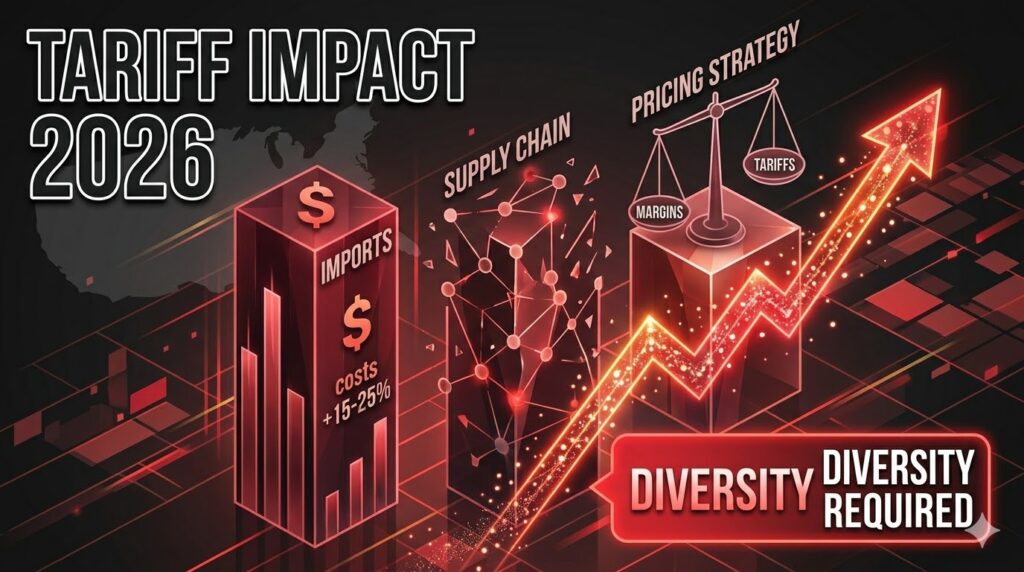

The 2026 tariff environment is the most disruptive trade landscape U.S. small businesses have faced since World War II. With average import tariff rates reaching approximately 17% across all U.S. imports — the highest level since 1946, per TariffsCost — and China-specific cumulative rates hitting 145%, the cost impact on supply chains is severe and, for many businesses, existential. The National Federation of Independent Business (NFIB) 2026 Trade Impact Survey found that 61% of small businesses report negative operational impacts from current tariff levels.
Yet the businesses surviving — and some thriving — in this environment share a common trait: they acted early, strategically, and comprehensively. This guide covers everything U.S. small business owners need to know about 2026 tariffs: what they cost, how to calculate the real impact on your margins, legal strategies for minimizing duties, supply chain diversification frameworks, pricing tactics that protect revenue without losing customers, and access to capital to bridge cash flow gaps. From foreign trade zones to USMCA compliance, from HS code reclassification to duty drawback, this is the most comprehensive tariff survival guide available for U.S. SMBs in 2026.
At-a-Glance: Current U.S. Tariff Rates by Origin (March 2026)
| Country / Origin | Tariff Rate | Key Affected Products | Relief Mechanisms |
|---|---|---|---|
| China | 145% cumulative | Electronics, apparel, furniture, industrial components | Section 301 exclusions (limited); FTZ; reclassification |
| Canada (USMCA-compliant) | 0% | Auto parts, agricultural goods, manufactured goods | USMCA rules of origin compliance required |
| Mexico (USMCA-compliant) | 0% | Auto, electronics, agricultural goods | USMCA rules of origin; some steel/aluminum carve-outs |
| European Union | 10% baseline + sector-specific | Steel, aluminum, autos, chemicals | Baseline reciprocal; sector negotiations ongoing |
| Vietnam | 10% baseline (up from 0%) | Apparel, footwear, electronics assembly | Better than China; still meaningful cost |
| India | 10–26% baseline | Textiles, pharmaceuticals, IT hardware | Varies by HS code; some pharma exempted |
| South Korea | 10% baseline | Semiconductors, auto parts, steel | Some tech product exclusions under negotiation |
| Japan | 10% baseline | Automotive parts, machinery, electronics | Bilateral negotiations ongoing |
| Steel & aluminum (all origins) | 25–50% | All steel/aluminum products | Section 232 exclusions (product-specific) |
| Automobiles (all origins) | 25% | Assembled vehicles and major parts | USMCA-compliant content exempted |
Source: TariffsCost — Trump Tariffs 2026 Complete Guide; Gray Group International — 2026 Tariffs and Small Business; TariffCenter.AI — Pricing Strategy in the Tariff Era. Rates as of March 2026; verify at USITC before business decisions.
Methodology: How We Evaluated Tariff Mitigation Strategies
This guide evaluates tariff mitigation strategies across five criteria:
| Criterion | Weight | Description |
|---|---|---|
| Cost reduction effectiveness | 30% | Actual duty reduction achievable; documented case results |
| Implementation speed | 20% | Time from decision to tariff savings realization |
| Compliance risk | 20% | Legal certainty; potential for CBP audit or penalty |
| Applicability to SMBs | 20% | Accessible without Fortune 500 legal/logistics budget |
| Scalability | 10% | Can grow with the business; not a one-time fix |
Data sourced from: Gray Group International, TariffCenter.AI, TariffsCost, IndustryWeek, Harvard Business Review, U.S. Customs and Border Protection (CBP), U.S. Trade Representative (USTR), and National Small Business Association (NSBA) 2026 surveys.
Section 1: Calculating the Real Tariff Impact on Your Business
Before implementing any mitigation strategy, you must understand the precise financial impact of tariffs on your business. Most small businesses underestimate tariff costs because they focus on the headline rate rather than the true landed cost increase.
The Landed Cost Formula
Landed Cost = (Product Cost + Ocean/Air Freight + Insurance) × (1 + Tariff Rate) + Customs Brokerage + Local Delivery + Warehousing
Example: A home goods importer buys $100,000 of product from China at an original 7.5% tariff rate:
| Cost Component | Pre-2026 (7.5% tariff) | 2026 (145% tariff) | Change |
|---|---|---|---|
| Product cost (FOB) | $100,000 | $100,000 | — |
| Ocean freight + insurance | $8,000 | $8,000 | — |
| Tariff (on CIF value) | $8,100 (7.5%) | $156,600 (145%) | +$148,500 |
| Customs brokerage | $500 | $500 | — |
| Total landed cost | $116,600 | $265,100 | +$148,500 (+127%) |
| Unit cost (10,000 units) | $11.66/unit | $26.51/unit | +$14.85/unit |
| Retail margin at $35/unit | 67% | 24% | -43 points |
This example, based on the real-world case documented by Gray Group International, illustrates why many China-dependent importers face existential margin compression. A business that was profitable at $11.66/unit with 67% margin is now operating at near-breakeven at $26.51/unit with 24% margin — insufficient to cover operating expenses, marketing, and overhead.
Tariff Impact Diagnostic: 5 Questions to Answer Now
- What is your current China-sourced revenue as a % of COGS? If over 40%, you have critical tariff exposure requiring urgent action.
- What are the precise HS codes for your top 10 imported products? Tariff rates are product-specific; the headline rate may not apply to your exact product.
- Do your supplier contracts include tariff pass-through clauses? Many suppliers are attempting to pass some or all of the tariff increase to buyers in contract renewals.
- What is your average inventory turn cycle? Businesses with longer inventory cycles (90+ days) have more time to implement sourcing changes before they run out of pre-tariff inventory.
- What is your customer price sensitivity? B2B customers and specialized product buyers can absorb price increases better than mass-market consumer goods buyers.
Section 2: Supply Chain Diversification — Moving Beyond China
The most fundamental and durable tariff mitigation strategy is reducing dependence on Chinese manufacturing. However, this is not a quick process — quality issues, MOQ (minimum order quantity) challenges, lead time changes, and supplier development costs make nearshoring and friendshoring a 12–24 month initiative for most small businesses.
Alternative Sourcing Countries: Cost-Benefit Analysis
| Country | Current Tariff Rate | Labor Cost vs. China | Quality / Lead Time | Best Industries | Key Risk |
|---|---|---|---|---|---|
| Vietnam | 10% | 20–30% lower | Good; 25–35 day sea freight | Apparel, footwear, electronics assembly | Capacity constraints; some Chinese-owned factories |
| India | 10–26% | 25–35% lower | Variable; 28–38 days | Textiles, pharmaceuticals, IT hardware, jewelry | Logistics infrastructure; quality consistency |
| Mexico (USMCA) | 0% if compliant | 30–40% lower than China all-in | Excellent; 5–10 day truck | Automotive, electronics, plastics, food | USMCA rules of origin compliance required |
| Taiwan | 10% | Higher than China | Excellent; 14–18 days | Semiconductors, precision components, electronics | Cross-strait geopolitical risk |
| Thailand | 10% | 10–20% lower | Good; 28–35 days | Auto parts, electronics, chemicals | Limited manufacturing scale for SMBs |
| Indonesia | 10% | 25–35% lower | Moderate; 30–40 days | Apparel, footwear, furniture, palm oil | Infrastructure; logistics costs |
| Poland/Eastern Europe | 10% (EU origin) | Higher than Asia | Excellent; 7–14 days truck | Precision manufacturing, aerospace, pharma | Higher labor cost vs. Asia |
The USMCA Opportunity: Mexico and Canada as Strategic Alternatives
The United States-Mexico-Canada Agreement (USMCA) — which replaced NAFTA in July 2020 — remains the most powerful tariff elimination tool available to U.S. small businesses in 2026. USMCA-qualifying goods from Mexico and Canada enter the U.S. duty-free, provided they meet rules of origin (ROO) requirements. The critical requirements:
- Regional Value Content (RVC): A specified percentage of the product’s value must originate in the USMCA region (varies by HS code; typically 50–75%).
- Tariff Classification Change: Inputs from outside the USMCA region must undergo a specified change in HS classification during manufacturing in a USMCA country.
- Specific rules by sector: Automotive goods require 75% RVC and steel/aluminum must be USMCA-origin. Apparel requires “yarn-forward” origin for most categories.
- Certificate of Origin: You (the importer) are responsible for claiming USMCA status and maintaining documentation. CBP can audit claims for 5 years.
The practical opportunity: if you can find a Mexican or Canadian supplier (or establish a contract manufacturing agreement) for goods currently sourced from China, you eliminate the tariff entirely. Mexico’s manufacturing infrastructure — particularly in Monterrey, Querétaro, and the Bajío corridor — has expanded dramatically since 2022 as Chinese-origin tariffs escalated. Lead times from Mexico to the U.S. border average 5–10 days by truck versus 25–35 days by sea from China, reducing working capital requirements as well.
Nearshoring Feasibility Assessment
| Factor | Favorable for Nearshoring | Unfavorable for Nearshoring |
|---|---|---|
| Product complexity | Standardized, repeatable manufacturing | Highly specialized, IP-intensive processes |
| Order volume | $500K+/year (sufficient for supplier interest) | Under $100K (too small for most factories) |
| Lead time sensitivity | Can absorb 12–18 month transition | Needs inventory continuity within 90 days |
| Labor content | High labor content (benefits from Mexico wage arbitrage) | Capital-intensive, automated production (location less critical) |
| Quality requirements | ISO-certified, measurable specs | Highly craft-intensive or cultural-knowledge dependent |
Section 3: Pricing Strategy in the Tariff Era — Surgical Adjustments
The worst thing a small business can do with tariff cost increases is apply a uniform price increase across all products. Per TariffCenter.AI, data-driven “surgical adjustment” — categorizing products by tariff exposure and price sensitivity — consistently outperforms blanket increases in preserving total profit. Nearly half of U.S. small businesses are raising prices in 2026; those with a strategic framework are retaining more customers and more margin than those using blanket increases.
The Tariff Pricing Matrix
| Product Category | Tariff Exposure | Customer Price Sensitivity | Recommended Strategy |
|---|---|---|---|
| Specialized / B2B contract items | High | Low (few alternatives) | Full pass-through: 100% tariff cost to price |
| Competitive consumer goods | High | High (easy substitution) | Partial absorption: 50-70% pass-through; review SKU mix |
| Commoditized items, thin margin | High | Very high | Discontinue or renegotiate supplier terms first |
| Premium / brand differentiated | Medium | Low-medium | Partial pass-through + brand story: ‘Made with quality components’ |
| Low tariff exposure items (domestic / USMCA) | Low | N/A | Hold price; capture share from competitors raising prices |
Communicating Price Increases to Customers
When price increases are unavoidable, communication strategy matters significantly for customer retention:
- Be transparent and specific: “Our costs increased X% due to U.S. government tariffs on [product origin]” is more credible than vague supply chain language. Customers understand government-imposed costs.
- Give advance notice: 30–60 days notice for B2B customers on contract is standard and legally expected in most vendor agreements. Surprise increases drive customer churn.
- Offer alternatives: A lower-cost substitute product, smaller packaging sizes, or a loyalty discount for long-term customers can soften the impact.
- Document cost evidence: Maintain supplier invoices showing tariff-related increases. If your customers push back, cost evidence supports your position in negotiations.
- Review contracts for escalation clauses: Many supply agreements include CPI or “material cost change” escalation provisions that legally allow price adjustments when input costs change materially. If your contracts lack this, add it at next renewal.
Section 4: Legal Tariff Mitigation Strategies
Strategy 1: HS Code Review and Reclassification
The U.S. Harmonized Tariff Schedule (HTS) contains over 12,000 product classifications at the 10-digit level. Two nearly identical products may be classified under different codes with dramatically different tariff rates. Working with a licensed customs broker to review your current HS classifications can reveal legitimate reclassification opportunities that reduce your duty liability without any change to your product or sourcing.
Example: A power tool accessory kit classified under 8467.99.0090 (general hand tool parts) may be reclassifiable under a more specific code with lower or zero tariffs if it meets the criteria of a specific subheading. The key: the reclassification must be legally defensible — CBP can audit and assess penalties for incorrect classifications. Always obtain a Customs Ruling (via CBP’s CROSS database) before relying on a reclassification for ongoing customs entries.
Strategy 2: Foreign Trade Zones (FTZs)
Foreign Trade Zones are secure areas, physically located in the U.S. but legally considered outside U.S. customs territory. Goods can be imported into an FTZ duty-free, stored, manipulated, manufactured, and then either re-exported (with no U.S. duty ever paid) or entered into U.S. commerce (with duty paid at that point). Key FTZ advantages for small businesses:
- Duty deferral: Pay duty when goods leave the FTZ for U.S. commerce — not when they arrive in the U.S. This improves cash flow, especially for businesses with long inventory cycles.
- Inverted tariff benefit: If the tariff rate on the finished good is lower than on its components, manufacturing in an FTZ allows duty payment at the lower finished-good rate. For example: importing steel components (25% tariff) to manufacture a product (5% tariff on the finished good) results in significant savings.
- Merchandise processing fee (MPF) reduction: FTZ weekly entries pay MPF once per week per zone versus per shipment, reducing MPF costs for high-frequency importers.
- Weekly entry and reduced inspections: FTZ operators benefit from consolidated CBP reporting and typically fewer individual shipment examinations.
There are 182 active FTZs in the U.S. as of 2026, plus hundreds of approved subzones. The FTZ Board’s online map shows all active zones. Many FTZs are operated by third-party logistics providers (3PLs) and warehouse operators — small businesses typically do not need to become FTZ operators themselves; they simply store or manufacture goods within an existing FTZ.
Strategy 3: Duty Drawback
Duty drawback allows companies to recover up to 99% of duties paid on imported goods that are subsequently exported, destroyed, or used in the manufacture of exported goods. Under 19 U.S.C. §1313, there are three main drawback types:
| Drawback Type | When It Applies | Recovery Rate | Complexity |
|---|---|---|---|
| Manufacturing drawback | Imported goods used to manufacture exported goods | 99% of duties paid | High — requires production records |
| Unused merchandise drawback | Imported goods exported in same condition as imported | 99% of duties paid | Medium — requires export evidence |
| Rejected merchandise drawback | Defective or non-conforming goods returned to supplier | 99% of duties paid | Low — common for quality rejects |
Drawback claims must be filed within 5 years of importation. CBP requires meticulous recordkeeping — import entries, production records (for manufacturing drawback), and export documentation. Many small businesses partner with a drawback specialist (fee: 10–25% of recovered duties) to file on their behalf. At 145% tariff rates on China-origin goods, even small export volumes can generate substantial drawback recoveries.
Strategy 4: Section 301 Tariff Exclusions
The U.S. Trade Representative (USTR) periodically opens windows for businesses to request product-specific exclusions from Section 301 China tariffs. Exclusions are granted when domestic U.S. sources are inadequate and the tariff causes disproportionate economic harm. Key points for 2026:
- The current round of exclusion requests focuses on industrial machinery, medical devices, and specialized components without U.S. alternatives.
- Exclusions are product-specific (tied to a specific HS subheading and sometimes a specific end-use or requestor) and time-limited (typically 12–24 months).
- Monitor USTR Federal Register notices for open comment periods. Small businesses can submit their own requests or support others’ requests.
- Even if exclusions are not currently available for your product, past exclusion rulings are precedent for future requests — maintain documentation of your economic hardship case.
Strategy 5: First Sale Valuation
Customs duties are calculated on the “customs value” of imported goods. By default, the customs value is the transaction value — the price actually paid or payable for the goods (essentially the invoice price). However, in multi-tier import transactions — where a manufacturer sells to a middleman/trading company who sells to the importer — the importer may be eligible to use first sale valuation, basing customs value on the original manufacturer-to-middleman price (typically lower) rather than the middleman-to-importer price. This legally reduces the dutiable value and, therefore, the duty paid. First sale valuation requires documentation of the entire transaction chain and CBP advance ruling in many cases.
Section 5: Working Capital & Financing in the Tariff Era
Higher tariffs require more working capital — duty must be paid at the time of importation, before goods are sold. A business importing $1 million of goods from China now faces $1.45 million in duty alone, paid upfront. This creates severe cash flow stress for small businesses with 60–90 day payment terms from customers. Key financing solutions:
| Financing Solution | Best For | Typical Rate / Cost | Speed to Fund |
|---|---|---|---|
| SBA 7(a) Working Capital Loan | Established businesses (2+ years) | 7.5–10.5% APR | 30–90 days |
| Import Trade Finance / Letter of Credit | Importers needing duty payment support | 1–3% of LC amount | 5–15 days setup |
| Invoice Factoring / AR Financing | B2B businesses with receivables | 1.5–5% per 30 days | 1–5 days |
| Inventory Financing / Asset-Based Lending | Businesses with significant inventory | Prime + 2–5% | 2–4 weeks |
| Supply chain finance / Dynamic discounting | Businesses with strong customer relationships | 1–3% of invoice | Real-time to 5 days |
| Business Line of Credit | Seasonal or variable import volumes | 6–20% APR | 1–7 days (existing); 2–4 weeks (new) |
The SBA’s Trade Finance Programs — including the Export-Import Bank working capital guarantee and SBA International Trade loans — specifically support businesses affected by trade policy changes. The SBA also administers the SBA 7(a) program with expanded limits for businesses demonstrating tariff-related cash flow needs. Work with an SBA-preferred lender (Wells Fargo, TD Bank, Live Oak Bank, Huntington) to expedite approval.
Section 6: Operational Strategies — Beyond Sourcing and Finance
Tariff-Aware Inventory Management
The tariff environment fundamentally changes optimal inventory strategy. Pre-tariff logic favored lean inventory (just-in-time, low carrying costs). Post-tariff logic for China-sourced goods may favor strategic pre-buying before further escalation or for products where sourcing alternatives are limited:
- Bonded warehouses: Goods can be stored in a customs-bonded warehouse without paying duty until withdrawn for consumption. This enables strategic inventory positioning without immediate cash outflow. Bonded warehouses charge storage fees ($0.50–$2.00/square foot/month) but defer duty payment — valuable for high-tariff, high-margin goods.
- Re-order point recalculation: Higher tariff costs mean higher landed cost per unit, which changes your economic order quantity (EOQ). Recalculate safety stock and reorder points based on new landed costs, especially if switching suppliers with longer lead times.
- SKU rationalization: High tariff exposure on low-margin SKUs may make them unprofitable. Conduct a full SKU profitability analysis at new landed costs and discontinue products that cannot be repriced adequately or sourced from lower-tariff origins.
Domestic Manufacturing: When It Makes Sense
For some product categories — particularly those with high labor content, where the tariff rate makes imports uncompetitive, or where “Made in USA” commands a premium — domestic manufacturing is now economically viable for the first time in decades. The Reshoring Initiative’s Total Cost of Ownership (TCO) Estimator helps businesses calculate the true comparative cost of offshore vs. domestic production, including tariffs, quality costs, inventory carrying costs, lead time costs, and intellectual property risk.
Sectors where domestic manufacturing has become competitive in 2026 include: steel fabrication, certain plastics and rubber goods, apparel for specialized markets, industrial machinery components, and consumer electronics accessories. Government incentives — including the Inflation Reduction Act manufacturing credits, CHIPS Act semiconductor incentives, and state-level industrial development grants — can further improve the economics of domestic production.
Section 7: Industry-Specific Tariff Impact and Strategies
Retail and Consumer Goods
Retailers are among the most severely impacted by 2026 tariffs. The National Retail Federation (NRF) estimates that consumers will pay $78 billion more annually for retail goods as a result of current tariff levels. Key strategies for retailers:
- Shift private label sourcing to Vietnam, India, or Mexico for apparel, home goods, and accessories.
- Use vendor cost transparency programs to negotiate tariff cost-sharing arrangements with suppliers.
- For e-commerce: leverage the de minimis threshold ($800 per shipment from individual customers in most countries) for direct-to-consumer dropshipping from non-China origins.
- Evaluate domestic dropshipping partnerships for fast-moving SKUs to reduce import dependency.
Manufacturing and Industrial
Manufacturers using China-sourced components face a complex calculation: absorb costs, pass through to customers, or invest in reshoring/nearshoring. The USMCA opportunity is particularly powerful for manufacturers, as components assembled in Mexico from global inputs can qualify as USMCA-origin if they meet the tariff classification change test or RVC requirements. Steel and aluminum users should prioritize USMCA-origin steel and consider applying for Section 232 product exclusions if their specific product configuration has no domestic alternative.
Technology and Electronics
Many electronic components, semiconductors, and finished devices face 145% tariffs from China. Strategies specific to this sector:
- Taiwan (10% tariff) remains a critical semiconductor source; the CHIPS Act has incentivized Taiwan Semiconductor Manufacturing Company (TSMC) to expand U.S. domestic production — a long-term but real reshoring option.
- India (10%) is rapidly scaling electronics manufacturing; Apple, Samsung, and others have shifted significant production. Small importers can access Indian electronics manufacturers through agents and sourcing platforms.
- Verify whether your electronic products qualify for the information technology agreement (ITA) tariff-free treatment for specific IT products under WTO agreements.
Agriculture and Food
Agricultural importers and food businesses face a mixed picture. Some agricultural products have USMCA protection (Canadian and Mexican produce, dairy, processed foods). Chinese agricultural imports face 145% tariffs plus any anti-dumping/countervailing duties (AD/CVD) already in place. Key strategies: maximize USMCA-origin sourcing for agricultural inputs; verify organic certification origin compliance; explore U.S. domestic sourcing for premium/specialty items where “American grown” commands consumer price premiums.
Section 8: Tax and Accounting Treatment of Tariffs
Tariffs are deductible business expenses — they are part of the cost of imported goods and flow into cost of goods sold (COGS). Key accounting and tax considerations:
- COGS treatment: Tariffs paid on inventory are capitalized into inventory cost under GAAP and tax rules (IRC §263A for businesses meeting the UNICAP threshold). When inventory is sold, the tariff cost flows to COGS, reducing taxable income in the year of sale.
- Tariff refunds (drawback): Drawback recoveries are taxable income in the year received. Maintain proper books to offset against original duty expense.
- Section 199A (QBI deduction): For pass-through entities (S-corps, LLCs, sole proprietors), higher COGS from tariffs reduces qualified business income (QBI) and, therefore, the 20% QBI deduction available under the Tax Cuts and Jobs Act (as extended by the One Big Beautiful Bill Act). Model the net tax impact of tariff cost increases on your QBI deduction.
- Cash vs. accrual method: Cash-basis taxpayers deduct duties when paid; accrual-basis deduct when the liability is incurred (typically at time of import). In a year when tariffs escalate rapidly, accrual-basis businesses recognize more cost earlier — which may be advantageous for tax timing.
Alternatives to Consider
Beyond the major strategies covered above, small businesses should be aware of:
- Supplier-initiated tariff sharing: Some Chinese manufacturers, particularly larger factories with significant U.S. customer volume, are willing to absorb a portion of the tariff increase (reducing their margin) to retain customer relationships. This is more common for long-term buyers with significant annual purchase volumes ($500K+). It is always worth asking during contract renewal negotiations.
- Product redesign for tariff optimization: Engineering products to use components sourced from lower-tariff countries — even if final assembly remains in China — can reduce the dutiable value of the finished good (first sale or value-added approaches). This requires close coordination with product engineers and customs advisors.
- Temporary importation bond (TIB): Goods imported for repair, alteration, or processing and then re-exported can enter duty-free under a TIB. Useful for businesses with international repair/service operations.
- Export-focused relocation: For businesses that sell primarily to international markets, establishing a manufacturing or distribution operation in a third country (Mexico, Canada, or a free-trade-zone country) can eliminate U.S. import duties entirely by shipping internationally without entering U.S. customs territory.
Limitations & Critical Perspective
This guide provides a comprehensive framework for navigating 2026 tariffs, but important limitations apply:
- Tariff rates change rapidly. The current tariff environment reflects executive orders, USTR actions, and court decisions that can change on short notice. The U.S.-China tariff situation in particular has seen multiple escalations and partial rollbacks. Always verify current rates at USITC.gov before any business decision.
- USMCA rules of origin are complex. Many businesses assume that manufacturing in Mexico qualifies goods for zero tariffs, but USMCA rules of origin can require significant local value addition. A product assembled in Mexico from mostly Chinese components may not qualify. Always get a legal opinion before relying on USMCA origin claims.
- HS code reclassification carries audit risk. CBP has increased audit activity in 2025–2026 specifically targeting tariff evasion through misclassification. Always obtain a customs ruling before relying on a reclassification for ongoing import entries.
- The information in this article does not constitute legal, customs, or tax advice. Tariff law and trade regulations are complex, vary by product and situation, and change frequently. Engage a licensed customs broker, trade attorney, and CPA before implementing any tariff mitigation strategy.
Frequently Asked Questions
Are the 2026 tariffs on China permanent?
Current tariffs were imposed through executive authority under Sections 232 and 301 of trade law, and through broader presidential emergency powers. They can be modified, reduced, or eliminated by the executive branch without Congressional approval — meaning they can change with any future administration. However, bipartisan political support for some form of China trade restriction exists in both parties, and complete tariff elimination is unlikely in the near term. Plan for a 3–5 year minimum timeline at elevated tariff levels when making sourcing investments.
How do I find my product’s HS code?
The U.S. International Trade Commission maintains the Harmonized Tariff Schedule (HTS) database online. You can search by product description or browse the schedule. For complex or ambiguous classifications, request a binding ruling from U.S. Customs and Border Protection (CBP) through their CROSS online ruling system — it is free and provides legal certainty. Your licensed customs broker can also assist with classification research.
Can I get a refund on tariffs already paid?
Yes, through duty drawback (for exported goods), post-summary corrections (if you were overcharged at entry), and protests filed within 180 days of liquidation. For Section 301 China tariffs, court challenges (e.g., the CIT/CAFC litigation over Lists 3 and 4 tariffs) have resulted in some refund opportunities for specific product categories — consult a trade attorney about pending litigation relevant to your products. Additionally, some tariff exclusions have retroactive effect, allowing refund claims for duties paid during the exclusion period.
How do I qualify my products for USMCA zero-tariff treatment?
USMCA qualification requires: (1) your goods originate in the U.S., Canada, or Mexico; (2) they meet the applicable rule of origin (tariff shift, RVC, or specific process rule) for their HS code; (3) you maintain documentation supporting origin (supplier declarations, production records, bills of materials); and (4) you certify origin on a USMCA certificate of origin (no specific form required, but must include all elements specified in Annex 5-A of the USMCA agreement). Importers must provide the USMCA certification to CBP at entry. Customs brokers specializing in USMCA compliance — such as Flexport or Customs City — can assist with compliance programs.
What is the penalty for tariff evasion or misclassification?
CBP can assess penalties under 19 U.S.C. §1592 for fraud (up to 4x the unpaid duties), gross negligence (up to 4x), and negligence (up to 2x). In fraud cases, criminal prosecution is possible. In addition, misdeclared origin (claiming USMCA for non-qualifying goods, or falsely declaring country of origin) can result in seizure and forfeiture of the goods. The risk of aggressive audit activity is elevated in 2026 given CBP’s focus on tariff enforcement. Invest in proper customs compliance rather than risk these penalties.
Should I pass all tariff costs to my customers?
It depends on your competitive position, customer contracts, and product price sensitivity. A full pass-through strategy works best when: (a) all competitors face the same tariff (same China origin), (b) your product has few substitutes, or (c) you serve B2B customers with cost-plus pricing relationships. A partial absorption strategy is better when: (a) some competitors have lower-tariff alternative sourcing, (b) you are in a consumer goods category where price drives purchase decisions, or (c) you have high customer lifetime value and cannot afford churn. Never make uniform pricing decisions — analyze each product category separately.
Bottom Line: Your 2026 Tariff Action Plan
Navigating 2026 tariffs requires immediate action on multiple fronts simultaneously. The businesses emerging strongest are those that:
- Know their exact tariff exposure by product, HS code, and origin — not just a rough estimate.
- Have a 12-month sourcing diversification roadmap with specific alternative suppliers identified and qualification timelines set.
- Use legal tariff mitigation tools (FTZs, drawback, HS reclassification, USMCA) to reduce duty burden without sourcing changes.
- Apply surgical pricing — full pass-through on specialty products, partial absorption on competitive items, SKU rationalization on unprofitable tariff-heavy products.
- Have secured working capital to fund higher landed costs without jeopardizing operations.
- Monitor tariff policy actively — subscribe to USTR Federal Register alerts and maintain a licensed customs broker relationship for real-time guidance.
Useful resources:
→ USITC — U.S. Harmonized Tariff Schedule
→ CBP — CROSS Customs Ruling Database
→ FTZ Board — Foreign Trade Zone Map
→ USTR — USMCA Agreement Text and Guidance
→ SBA — 7(a) Working Capital Loans
→ Reshoring Initiative — Total Cost of Ownership Estimator
→ HBR — 10 Rules for Navigating Global Tariffs
Information as of March 2026. Tariff rates, exclusions, and trade regulations change frequently. Verify all rates at USITC.gov and consult a licensed customs broker or trade attorney before making business decisions.
