

Advertising & Editorial Disclosure: We independently research and report on marketing technology and customer analytics. If you click links we provide, we may receive compensation from vendors or partners. Product and vendor information is as of March 2026 and may change. None of the platforms or vendors featured in this article sponsored this content. We may receive affiliate compensation if you sign up through our links. This article is for informational purposes only and does not constitute professional or investment advice. Consult qualified advisors before making technology or business decisions. Learn more.
U.S. businesses are sitting on a goldmine of customer data. The challenge is turning that data into dollars—increased revenue, higher retention, and optimized customer lifetime value (CLV). AI-powered customer analytics, deployed through Customer Data Platforms (CDPs), personalization engines, and predictive models, enable companies to move from reactive reporting to proactive monetization. This article explores how modern enterprises use these technologies to drive measurable business outcomes while navigating privacy regulations and the decline of third-party cookies.
We draw on research from McKinsey, BCG, Harvard Business Review, Gartner, Salesforce, Adobe, Segment, SecurePrivacy, and 30+ authoritative sources as of March 2026.
At-a-Glance: How U.S. Businesses Monetize AI-Powered Customer Analytics
| Monetization Lever | Technology | Typical ROI / Impact | Key Platforms |
|---|---|---|---|
| Unified customer profiles | CDP with AI | 3000% ROI, 79% conversion lift (Red Hat case) | Salesforce Data 360, Adobe RTCDP, Segment |
| Real-time personalization | AI personalization engine | 20–29% conversion, 35% CTR lift | Relewise, Experro, SPARQUE.AI |
| Predictive CLV & churn | ML models | 20–35% revenue uplift; 15–25% churn reduction | Adobe Customer AI, H2O.ai, Pendo Predict |
| First-party data activation | Privacy-first CDP | 4–7x ROAS vs third-party; 95%+ match rate | LiveRamp, Treasure Data, Zeotap |
| Attribution & measurement | AI attribution | 50% better accuracy; MER 5x target | Incrementality testing, MMM |
Customer Data Platforms (CDPs) with Integrated AI
Customer Data Platforms unify customer data from marketing, sales, service, commerce, and other sources into a single system to create unified profiles, enable segmentation, and activate data across channels. Per Gartner’s 2026 Magic Quadrant, CDPs are now evaluated as enterprise data strategy decisions—not just marketing tools—with cross-functional buying groups involving IT, sales, marketing, supply chain, finance, and customer service. The market is incorporating agentic process optimization, with CDPs expected to offer packaged AI agents for autonomous decision-making.
Leading CDP platforms combine multiple AI approaches: predictive AI to anticipate customer behavior and churn, agentic AI for autonomous campaign optimization, generative AI for scaled personalization, and conversational interfaces for natural language queries and segment creation. Blueshift reports clients seeing 41% higher engagement and 22% increase in sales. Zeotap emphasizes 3x faster deployment compared to traditional CDPs with improved match rates and data enrichment. LiveRamp launched agentic AI upgrades for audience building, measurement, and campaign optimization.
Salesforce Data 360 achieved 141% year-over-year growth in paying customers per Gartner. It includes Agentforce integration for AI-assisted audience segmentation using natural language, custom predictive AI models, and connections to Amazon SageMaker and Google Vertex AI. Adobe Real-Time CDP offers Customer AI for individual-level propensity scores (conversions, churn), ML-powered audience segmentation, and real-time data collection and activation. Both platforms support cross-channel personalization and data unification.
Treasure Data launched Treasure Code, an AI-native command-line interface allowing technical teams and AI agents to operate the entire CDP as code—achieving rapid adoption with over a quarter of their customer base using it within days. Insider positions itself as an AI-native CDP for enterprise-level CX orchestration. The market is consolidating around integrated platforms rather than point solutions, with emphasis on operational efficiency through code-grade governance, DevOps-style automation, and governed AI agent access.
Real-Time Personalization: From Batch to Milliseconds
AI personalization engines deliver real-time, individualized experiences across digital and physical touchpoints. These systems adjust product recommendations, content, and offers based on live customer behavior—search queries, browsing patterns, and cart actions—within milliseconds rather than relying on prior session data. Per Redis, systems typically operate within a 200-millisecond latency budget end-to-end.
Real-time personalization requires a three-layer architecture: a data layer for ingestion and feature storage, a processing layer for stream computation, and a serving layer for recommendations and caching. Platforms like Relewise, Experro, and Rierino offer enterprise-scale solutions combining machine learning, natural language processing, and real-time data processing. Results vary by deployment: vendors report 20–28% conversion rate increases, 29% revenue growth, and 3-month ROI timelines under favorable conditions—actual outcomes depend on data quality, integration depth, and industry.
| Personalization Capability | Business Impact | Source / Context |
|---|---|---|
| Product recommendations | 20–28% conversion lift | Vendor benchmarks; results vary by vertical |
| Search personalization | 35% CTR, 22% conversion gains | Experro; eCommerce focus |
| Content personalization | 29% revenue growth | SPARQUE.AI; 3-month ROI typical |
| Next-best-action | 3x ROI vs mass promotions | BCG; redirect 25% spend to personalized offers |
Predictive Analytics for Retail: CLV and Churn
Customer Lifetime Value (CLV) refers to the total revenue a customer generates for a brand over their entire relationship. Predictive CLV uses historical data and machine learning to forecast future customer behavior and purchasing patterns, enabling retailers to move beyond reactive reporting to proactive decision-making. Per Digital Applied, organizations implementing AI-powered CLV models see 20–35% revenue uplift in customer lifetime value, 3–5x campaign ROI gains through targeted engagement, and churn prediction accuracy of 85–92% when properly engineered.
Churn prediction models analyze behavioral patterns (subscription changes, support interactions, purchase frequency), transactional data (payment failures, return rates), and engagement metrics (email opens, loyalty participation). Well-trained models achieve 75–85% accuracy in identifying customers likely to churn within 30 days, providing a 2–4 week intervention window. One Mnemonic AI case study showed 15% churn reduction and $2.4M in revenue savings with 68% save rate on at-risk accounts detected 30 days early. Acquiring new customers costs 5–25x more than retaining existing ones.
Quantzig reports 15% increase in customer lifetime revenue and 20% improvement in retention rates through predictive analytics. Effective implementation requires data unification across POS, eCommerce, CRM, loyalty platforms, and behavioral signals; feature engineering to identify variables that drive outcomes; predictive modeling; and decision activation by embedding predictions into marketing automation and workflows.
ROI Case Studies: Before and After Metrics
Concrete ROI examples illustrate the monetization potential of AI-powered customer analytics. Red Hat achieved a 3000% annual ROI and $1 million in operational savings through CDP implementation with a first-party data strategy—79.4% increased conversions from first-party campaigns and 196% decrease in cost-per-lead. Danone Nutricia achieved 418% ROI through phased CDP implementation that unified fragmented customer data and addressed third-party cookie deprecation.
A U.S. convenience store chain saw $400K in promotional spend savings and 10% campaign performance lift across 5,000+ stores using ML-driven customer analytics on Databricks. MediaMarkt, Europe’s largest consumer electronics retailer, achieved 14% revenue uplift per user through McKinsey’s personalization optimization. Retailers using McKinsey’s “category accelerator” approach have achieved 3–5% sales uplifts and 1–4 percentage point net margin improvements within 6–18 months.
| Company | Initiative | Before/After Metric | Source |
|---|---|---|---|
| Red Hat | CDP + first-party data | 79.4% conversion lift; 196% CPL decrease | GoFurther case study |
| Danone Nutricia | Phased CDP | 418% ROI | EW Solutions |
| US convenience chain | ML on Databricks | $400K savings; 10% campaign lift | LatentView |
| MediaMarkt | Personalization optimization | 14% revenue uplift per user | McKinsey Periscope |
| BVK (agency) | Unified data on Snowflake | 75% cost reduction; 50% faster dashboards | Snowflake |
First-Party Data Strategy: The Post-Cookie Imperative
Google completed its phase-out of third-party cookies in Chrome (with a later user-choice model), while Safari and Firefox block third-party cookies by default. Per Caramel, 96% of web browsers block third-party cookies by default. The shift toward first-party data is permanent. Yet Adobe’s study found that while 78% of brands have adopted CDPs, only 26% successfully activate first-party data across the organization—65% are still in process. Brands feel less prepared than in 2022 despite reduced reliance on third-party cookies.
First-party data includes purchase history, preferences, engagement metrics, feedback, and behavioral data collected with consent through owned channels (website, app, loyalty program, email, POS). Zero-party data is information customers voluntarily share—preferences, intent, context—often through surveys, preference centers, or interactive experiences. Both outperform third-party data on accuracy, cost, and customer sentiment. Per Caramel, 68% of customers have positive sentiment toward first-party personalization vs. 78% negative toward third-party tracking.
Technical implementation requires connecting CRM systems to Google Ads, Meta, LinkedIn, and Microsoft; passing hashed first-party identifiers and business outcomes (SQLs, pipeline, revenue); and using Enhanced Conversions and Offline Conversion Import for closed-loop measurement. Consent Management Platforms (CMPs) must be integrated for GDPR/CCPA compliance. Plan for three browser realities: Chrome’s permissive model, Safari’s strict blocking, and Firefox’s partitioned cookies.
Privacy-First Marketing: Using Data Without Violating Trust
Privacy-first marketing has become essential as regulatory enforcement escalates and consumer trust erodes. Per Matomo’s 2025 Ethical Marketing Field Guide, 76% of consumers refuse to buy from companies they don’t trust with data. First-party data collected directly from customers significantly outperforms third-party alternatives: first-party segmented campaigns deliver 4–7x ROAS vs. 1.5–2.5x for third-party lookalikes, 95%+ match rate vs. 35–45% for third-party data, and 40–60% lower CPMs, per Caramel.
Privacy-first marketing prioritizes zero-party data (information customers voluntarily share) and first-party data (collected through owned channels) instead of third-party tracking. This requires explicit informed consent, data minimization, and transparency. Legacy analytics platforms built on third-party cookies and cross-site tracking fail under GDPR, CCPA, and browser-level privacy changes (Safari ITP, Chrome’s cookie deprecation). Per Layer Five, 51% of CTOs don’t trust their marketing platform data, and $66+ billion annually in marketing spend is wasted due to broken attribution.
Effective privacy-first stacks include cookie-free or low-cookie analytics focusing on aggregates, server-side event collection, revenue tracking using minimal identifiers (hashed IDs), and consent management integrated into workflows. Ketch and similar platforms unify consent, preferences, and personalization controls while enabling zero-party data activation across martech ecosystems.
Harvard Business Review’s Data Monetization Framework
Harvard Business Review frames data monetization around three core questions: Who are your data customers? What problems will the data solve? And what is your monetization method? Rather than a one-size-fits-all approach, companies should start with their core businesses and existing partners. HBR identifies three monetization methods: Selling—direct exchange of data for money through subscriptions or licensing; Improving—using data to create operational efficiencies that reduce costs or improve speed; and Wrapping—enhancing existing products with data so customers purchase more.
Organizations can choose between direct monetization (selling data) and indirect approaches that embed data into existing offerings. The more complete the offering—from raw data to bundled insights to commercially ready products—the greater the potential for strategic differentiation. Success requires addressing privacy, regulatory compliance, and reputational risk from day one. Universal Music Group’s “Fan Analytics, Marketing, and E-commerce” (FAME) tool compiled data from retail, e-commerce, social media, and CRM to help labels and artists identify growth opportunities—illustrating how effective data monetization often involves sharing data to generate value through cross-company synergies.
BCG’s $70 Billion Personalization Opportunity
BCG research estimates that redirecting 25% of mass promotion spending to personalized offers would increase ROI by 200%, creating over $70 billion in annual top-line growth opportunity. Personalized offers generate returns as much as three times higher than mass promotions—yet most retailers still invest less than 5% of promotional spending in personalization. Personalization leaders in retail grow revenue 10 percentage points faster annually than laggards. Top retailers on BCG’s Personalization Index can achieve an estimated $570 billion in incremental growth by harnessing first-party data.
Large retailers can generate over $100 million in topline impact from personalized offers at scale, precision-targeted ads, product recommendations, and next-best experience engines. Retail media advertising, fueled by first-party data, grows 25% annually and helps fund necessary technology and data investments. Four-fifths of consumers are comfortable with personalized experiences and expect companies to offer them—though two-thirds have had at least one negative personalized experience that caused disengagement, underscoring the need for relevance and respect for privacy.
AI Marketing Attribution and ROI Measurement
Measuring AI marketing ROI requires frameworks that account for privacy constraints and multi-touch journeys. Per Digital Applied, the Marketing Efficiency Ratio (MER)—total revenue divided by total AI spend—is emerging as a CFO-friendly metric with a target of 5.0x. Traditional Multi-Touch Attribution (MTA) has become unreliable due to privacy laws and cookie blocking. Incrementality testing using a 10% Universal Holdout Group that never sees AI ads, then comparing LTV against the exposed group, provides the most statistically defensible ROI measurement.
Experts recommend layering three approaches: platform data (Google/Meta) for optimistic estimates, Marketing Mix Modeling (MMM) for strategic analysis ($50–150K/year), and geo-lift incrementality tests for ground truth. AI-driven attribution systems use machine learning to adapt to actual customer behavior; companies implementing AI attribution achieve 50% better accuracy compared to traditional models. “Shadow ROI”—operational savings from reduced agency fees and staffing—often exceeds direct revenue gains; AI-first marketing teams report up to 10.8% overhead cost reductions.
Implementation Roadmap: From Pilot to Scale
Organizations that successfully monetize AI-powered customer analytics typically follow a phased approach. Phase 1 (0–3 months): Audit existing data—first-party sources, consent coverage, integration gaps. Define 1–2 high-impact use cases (e.g., churn prediction, first-party activation for paid media). Establish baseline metrics (current CLV, retention rate, campaign ROAS) to measure improvement. Phase 2 (3–6 months): Implement a CDP or data unification layer. Prioritize identity resolution and consent management. Run pilot campaigns using first-party segments; measure incrementality vs. holdout. Phase 3 (6–12 months): Deploy predictive models (CLV, churn) and integrate into marketing automation. Scale personalization across web, email, and paid channels. Implement AI attribution or MMM for ROI measurement.
Common pitfalls include over-investing in technology before data quality is addressed, underestimating implementation and change management costs, and expecting immediate ROI—most programs see meaningful results in 6–12 months. Forrester notes that enterprises increasingly demand seamless experiences and fast support from analytics providers, mirroring the user-friendly experiences they encounter with tools like ChatGPT. Agentic AI preparation—reducing manual intervention while maintaining human oversight for integration and monitoring—is a key trend.
Methodology: How We Researched This Article
We evaluated AI-powered customer analytics monetization using the following approach:
- Primary sources: McKinsey, BCG, Harvard Business Review, Gartner Magic Quadrant, Adobe, Salesforce, Segment, LiveRamp, and vendor documentation with direct URLs where available.
- Case studies: Red Hat, Danone, LatentView, Quantzig, Mnemonic AI, GoFurther, Snowflake—with attribution to specific reports.
- Industry reports: Forrester Customer Analytics Wave, Adobe cookie study, Caramel first-party data guide, Layer Five attribution analysis.
- Vendor benchmarks: Blueshift, Zeotap, Relewise, Experro—noted as vendor-reported; results vary by deployment.
Sources consulted (30+): McKinsey (five facts, Periscope, category accelerator), BCG (personalization, $70B opportunity), HBR (data monetization), Gartner (CDP Magic Quadrant 2026), Adobe (RTCDP, Customer AI, cookie study), Salesforce (Data 360), Segment, Twilio, mParticle, LiveRamp, Treasure Data, Zeotap, Blueshift, Insider, Relewise, Experro, Rierino, SPARQUE.AI, Redis, Digital Applied, Spotler, LatentView, Quantzig, Mnemonic AI, H2O.ai, Pendo, GoFurther, EW Solutions, Snowflake, Caramel, SecurePrivacy, Layer Five, Postmetric, Matomo, Ketch, Pimms, Hypermind AI, Everworker, Finsi.ai, Genesys Growth, CxToday, Business Wire.
Alternatives to Consider
Beyond the CDPs and platforms highlighted above, several alternatives merit evaluation depending on use case and budget:
- Tealium — Gartner Challenger with 1,300+ integrations; strong for enterprises needing broad tag management and audience orchestration.
- RudderStack — Warehouse-native CDP offering 50–80% cost savings vs. Segment for data engineering–centric teams.
- Amplitude — Product analytics and experimentation; strong for product-led growth and cohort analysis; includes AI-powered experimentation.
- Mixpanel — Real-time funnel and retention analytics; well-suited for B2B and startups with account-level analytics.
- mParticle — Mobile-first CDP with Cortex AI predictive modeling; ideal for app-centric businesses.
Open-source and warehouse-native options (e.g., RudderStack, dbt + Segment) can reduce costs for technical teams. Smaller businesses may find all-in-one tools like HubSpot or Mailchimp sufficient before scaling to enterprise CDPs.
Limitations & Critical Perspective
AI-powered customer analytics deliver measurable results, but several caveats apply:
- Implementation costs: Enterprise CDPs and AI personalization platforms typically require $50K–$500K+ annually in licensing, implementation, and data engineering. ROI timelines of 3–12 months are common but not guaranteed.
- Data quality: Garbage in, garbage out. Unified profiles and predictions depend on clean, consented, first-party data. Many organizations struggle with siloed systems and legacy data quality issues.
- Privacy and compliance: GDPR, CCPA, and browser changes constrain tracking. Privacy-first approaches may reduce granularity but improve trust and long-term sustainability.
- Vendor benchmarks: Claims like “20–29% conversion lift” or “35% CTR increase” come from vendor case studies under favorable conditions. Your results will vary by industry, data maturity, and integration depth.
- Attribution uncertainty: $66B+ in marketing spend is wasted on broken attribution. Incrementality testing and MMM are more reliable than last-click but require investment and expertise.
Not every business needs an enterprise CDP. Start with clear use cases (e.g., first-party activation, churn prediction, personalization) and validate ROI before scaling. Forrester’s Customer Analytics Services Wave and Gartner’s CDP Magic Quadrant provide vendor evaluation frameworks; request demos and reference customers before committing.
Frequently Asked Questions
What is a Customer Data Platform (CDP)?
A CDP unifies customer data from marketing, sales, service, commerce, and other sources into a single system to create unified profiles, enable segmentation, and activate data across channels. Per Gartner, CDPs are now evaluated as enterprise data strategy decisions with cross-functional buying groups. Leading vendors include Salesforce Data 360, Adobe Real-Time CDP, Segment, LiveRamp, and Tealium.
What is an AI personalization engine?
An AI personalization engine uses machine learning to deliver real-time, individualized experiences—product recommendations, content, and offers—based on live customer behavior within milliseconds. Systems typically operate within a 200ms latency budget. Vendors report 20–29% conversion lifts and 35% CTR gains under favorable conditions; results vary by deployment.
How does predictive analytics improve retail ROI?
Predictive analytics forecast demand, churn risk, and customer lifetime value, enabling proactive decisions. Organizations report 20–35% revenue uplift in CLV, 3–5x campaign ROI gains, and 15–25% churn reduction. Churn prediction models achieve 75–92% accuracy when properly engineered. Implementation requires unified data, feature engineering, and activation into marketing automation.
What is customer lifetime value optimization?
CLV optimization uses predictive models to identify high-value segments, allocate marketing budgets proportionally, and reduce churn through targeted retention. Companies move from treating all customers equally to spending based on predicted value. BCG estimates $70B+ opportunity from redirecting 25% of mass promotion spend to personalized offers.
What is privacy-first marketing?
Privacy-first marketing prioritizes zero-party and first-party data over third-party tracking, with explicit consent, data minimization, and transparency. First-party campaigns deliver 4–7x ROAS vs. third-party; 76% of consumers refuse to buy from companies they don’t trust with data. Effective stacks use cookie-free analytics, server-side collection, and consent management.
How much does a CDP cost?
Enterprise CDPs typically range from $50,000 to $500,000+ annually in licensing, depending on data volume, connectors, and support. Implementation and data engineering add significant cost. Mid-market and SMB options (HubSpot, Segment Starter, RudderStack) offer lower entry points. ROI timelines of 3–12 months are common; validate use cases before full-scale deployment.
Bottom Line: From Data to Dollars
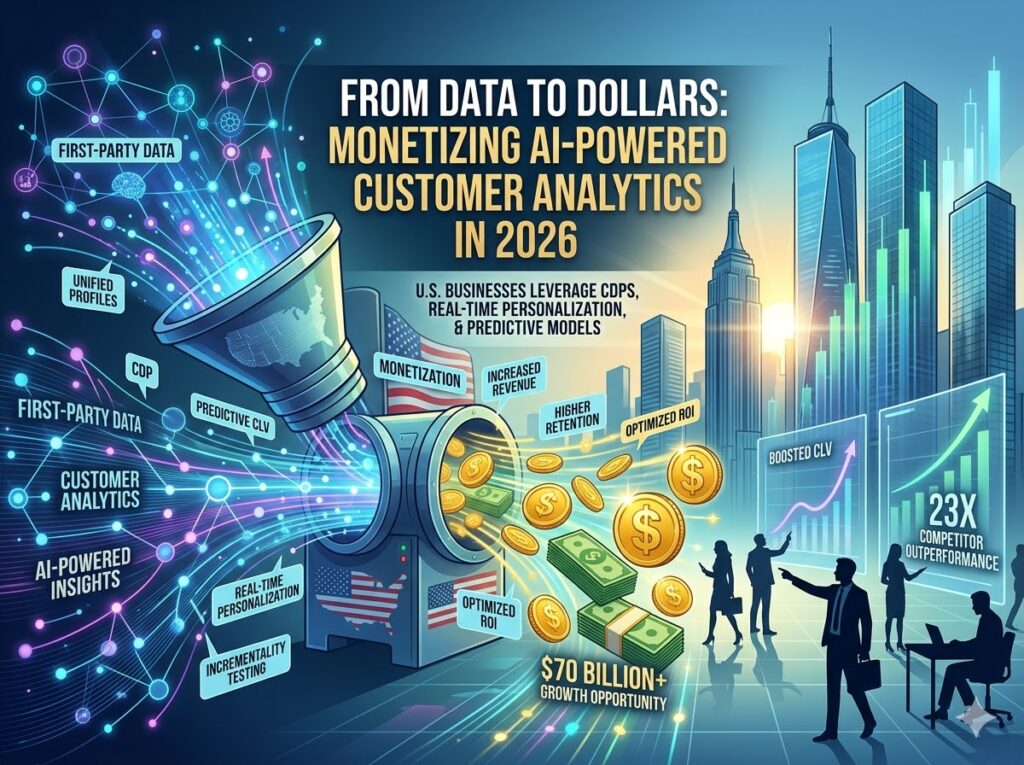
U.S. businesses monetize AI-powered customer analytics through unified CDPs, real-time personalization, predictive CLV and churn models, first-party data activation, and privacy-first measurement. Companies that extensively use customer analytics are twice as likely to generate above-average profits and 23 times more likely to outperform in new-customer acquisition. BCG’s $70 billion personalized-offers opportunity and case studies from Red Hat (3000% ROI), Danone (418% ROI), and MediaMarkt (14% revenue uplift) illustrate the potential.
Success requires data quality, clear use cases, and investment in implementation. Not every business needs an enterprise CDP—start with specific goals (first-party activation, churn prediction, personalization) and validate ROI before scaling. Privacy-first approaches are no longer optional; they build trust and deliver competitive advantage without sacrificing effectiveness.
Next steps:
- Audit your data — Assess first-party data quality, consent coverage, and integration gaps.
- Define use cases — Prioritize CLV optimization, churn prevention, or personalization based on business impact.
- Evaluate CDPs — Compare Salesforce, Adobe, Segment, Tealium, and alternatives against your requirements.
- Implement incrementality testing — Establish baseline ROI measurement before scaling AI-driven campaigns.
Resources:
→ McKinsey — Five Facts: How Customer Analytics Boosts Corporate Performance
→ BCG — Personalized Offers and the $70 Billion Prize
→ Gartner — Magic Quadrant for Customer Data Platforms
→ Salesforce — Data 360 CDP
→ Adobe — Customer AI in Real-Time CDP
→ SecurePrivacy — Privacy-First Marketing Guide 2025
Information as of March 2026. Vendor offerings, benchmarks, and regulations change frequently. Verify details with providers and legal counsel before making investment decisions.
