

Advertising & Editorial Disclosure: We independently research and report on retail technology and AI solutions. If you click links we provide, we may receive compensation from technology vendors or partners. Product and vendor information is as of March 2026 and may change. This article is for informational purposes only and does not constitute professional or investment advice. Consult qualified advisors before making technology or business decisions. Learn more.
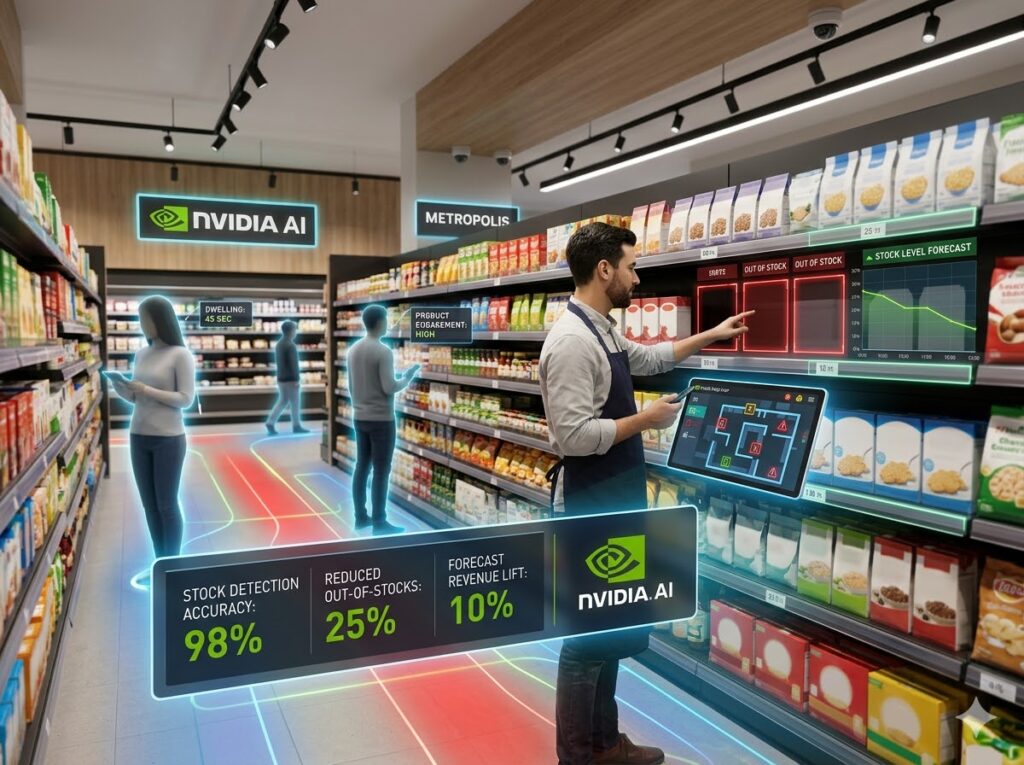
Modern retail companies are increasingly turning to artificial intelligence technologies powered by NVIDIA to improve operational efficiency, optimize inventory management, and increase in-store sales performance. By combining computer vision, machine learning, and real-time analytics on GPU-accelerated platforms, retailers can process large volumes of video feeds and transactional data to identify inventory shortages, analyze customer movement patterns, and anticipate product demand before stockouts occur.
This article explores how retail AI analytics, NVIDIA AI retail solutions, inventory optimization AI, and smart retail technology are transforming traditional retail operations. We draw on research from NVIDIA, NVIDIA Blog, McKinsey, Forbes, CamThink, Google Cloud, Chain Store Age, and other authoritative sources as of March 2026.
At-a-Glance: How NVIDIA AI Transforms Retail Operations
| Use Case | Technology | Business Impact | NVIDIA Platform |
|---|---|---|---|
| Shelf monitoring & stockout detection | Computer vision, edge AI | Reduce OOS; 95–99% detection accuracy vs 60–70% manual | Metropolis, DeepStream |
| Loss prevention & shrinkage | Video analytics, product recognition | Address $100B+ annual shrink; real-time theft detection | Retail Loss Prevention AI Workflow |
| Customer behavior analytics | Heat mapping, dwell time, occupancy | Optimize layout, staffing, merchandising | Retail Store Analytics AI Workflow |
| Demand forecasting | ML, time-series, multi-level aggregation | 8–11% revenue lift; 20–50% forecast accuracy gain | RAPIDS, Vertex AI, Databricks |
| Autonomous checkout | Grab-and-go, smart carts | Frictionless experience; higher margins | Omniverse, AiFi, Cooler Screens |
AI-Powered Inventory Management: From Manual Counts to Real-Time Visibility
Traditional inventory management relies on manual shelf walks conducted one to three times daily, creating detection lags of hours during which lost sales accumulate. Enterprise inventory and warehouse management systems track units through receiving and checkout but cannot see actual shelf conditions—leading to “phantom inventory,” where stock is recorded as available but physically inaccessible due to displacement, unopened cases, or items left in wrong aisles. Research from CamThink and Vision Platform indicates that phantom inventory accounts for 20–43% of all out-of-stock events, and enterprise systems structurally cannot detect these gaps.
Computer vision systems installed in retail environments—using ceiling-mounted, shelf-edge, or fixed cameras—continuously analyze shelf images in real time. AI models based on convolutional neural networks and approaches like Faster R-CNN and RF-DETR identify products, gaps, and empty facings. Edge processing runs detection on-device in under 100 milliseconds, eliminating cloud latency. Modern systems achieve 95–99% detection accuracy compared to 60–70% for manual audits, per CamThink.
NVIDIA’s approach integrates with existing camera infrastructure. The NVIDIA Metropolis platform can scan items to check stock levels and alert associates to restock, correct shelf location, and even adjust prices when needed. Partners like Cooler Screens combine digital signage with AI-based inventory checks to reduce stockouts and increase sales. Large retailers use AI to handle critical, repetitive tasks such as inventory counts or scanning for out-of-stock situations.
When U.S. consumers encounter empty shelves, NVIDIA reports that 20% postpone their purchase, 10% purchase elsewhere, and 16% shift to online—leading retailers to lose 46% of possible sales. AI-powered shelf monitoring converts detections into operational alerts, enabling staff to respond within minutes rather than hours.
In-Store Traffic and Customer Behavior Analytics
Beyond inventory, retailers analyze customer traffic inside stores using video analytics. AI models process anonymized visual data to identify movement patterns, dwell times, and high-engagement areas within the retail space. This information enables businesses to understand how customers interact with products, displays, and promotional areas—and to redesign store layouts, adjust product placement, and improve merchandising strategies to maximize product visibility and conversion rates.
The NVIDIA Retail Store Analytics AI Workflow, built on Metropolis microservices, provides queue analytics, shopper occupancy, dwell time and trajectory, heat mapping of the customer journey, proximity detection, line crossing, and regions-of-interest analysis. These attributes can be customized for individual stores. Retailers use this data to optimize staffing, enhance merchandising and layout, and improve customer experience to maximize sales.
Heat mapping visualizes customer density and movement patterns using color coding—red for high-traffic areas, blue for low-traffic zones—to identify where people gather and linger. Per Agrex AI and RetailNext, AI and deep learning on CCTV achieve 95–98% accuracy for people counting, heatmaps, dwell time, and demographics. IVA data can provide demographics and create heatmaps to reveal popular traffic areas inside stores, helping retailers deliver revenue-driving online and in-aisle promotions.
AI-Driven Demand Forecasting: Predicting Demand Before Stockouts
Retail companies combine AI analytics with historical sales data to predict product demand more accurately. Machine learning models identify trends influenced by seasonality, local events, promotions, or shifting consumer behavior. With more precise demand forecasting, retailers can adjust purchasing strategies, optimize warehouse distribution, and reduce both excess inventory and product shortages.
Per Google Cloud, a 10–20% improvement in forecast accuracy can produce a 5% reduction in inventory costs and a 2–3% increase in revenue. Retailers lose over a trillion dollars annually in mismanaged inventory. Stack AI and TechVerx report that AI-driven inventory optimization delivers 8–11% more revenue with less or same inventory, 6–8% gross margin increases, 80% time savings in planning, stockout reduction of 60–65%, inventory level reductions of 10–30%, and forecast accuracy improvements of 20–50%.
NVIDIA RAPIDS accelerated data science libraries enable retailers to perform demand forecasting, inventory management, and last-mile delivery analytics at scale. Processes that took days take minutes. NVIDIA and Google Cloud report 2.45x speedup with 20% cost savings versus CPU clusters for retail data analytics. McKinsey’s CommercialX uses AI to help retailers localize assortments at scale—a critical capability since uniform assortments increasingly miss local demand.
Retail Shrinkage: The $100 Billion Problem AI Helps Solve
Shrinkage—the loss of goods due to theft, damage, and misplacement—costs the global retail industry approximately $100–125 billion annually. An estimated 65% of shrinkage is due to theft, according to the National Retail Federation’s Retail Security Survey. Many retailers report theft has more than doubled recently, driven by rising prices.
NVIDIA’s Retail AI Workflows address this through three specialized workflows built on Metropolis microservices:
- Retail Store Analytics Workflow: Computer vision for store traffic trends, customer counts, basket usage, aisle occupancy.
- Multi-Camera Tracking AI Workflow: Tracks objects and associates across multiple cameras while maintaining shopper privacy through visual embeddings rather than biometric data.
- Retail Loss Prevention AI Workflow: Pre-trained models recognize hundreds of frequently stolen products (meat, alcohol, detergent) in various sizes and shapes. With synthetic data from NVIDIA Omniverse, retailers can customize models to hundreds of thousands of store products.
Kroger’s Vice President of Asset Protection & Safety, Mike Lamb, stated: “Self-checkout is the land of opportunity for organized theft. We’ve got to stay one step ahead and we’re going to accomplish that through AI.” Companies like RadiusAI (NVIDIA Inception member) and Jacksons Food Stores use AI with Lenovo and NVIDIA to address fuel theft and in-store bottlenecks.
GPU-Accelerated Computing: Why NVIDIA Powers Retail AI
GPU-accelerated computing platforms from NVIDIA enable these advanced analytics by processing large volumes of visual and operational data efficiently. Traditional CPUs struggle with the parallel processing required for real-time video analytics across dozens of camera feeds. NVIDIA GPUs—deployed in data centers, at the edge (e.g., NVIDIA Jetson), or in the cloud—deliver the throughput needed for inference at scale.
Key NVIDIA platforms for retail include:
| Platform | Role | Retail Applications |
|---|---|---|
| NVIDIA Metropolis | Vision AI application platform | Shelf monitoring, loss prevention, store analytics, IVA |
| NVIDIA DeepStream | Video analytics SDK | Real-time people detection, tracking, basket detection |
| NVIDIA TAO Toolkit | Model training and fine-tuning | Custom object detection, product recognition |
| NVIDIA RAPIDS | Accelerated data science | Demand forecasting, inventory optimization, analytics |
| NVIDIA Omniverse | Digital twin and simulation | Store layout optimization, synthetic data for training |
The Retail Store Analytics AI Workflow is delivered through cloud-native microservices deployable via Kubernetes and Helm, with pretrained models and customizable dashboards. This modular architecture allows retailers to scale from pilot stores to thousands of locations.
Business Impact: Operational and Financial Benefits
Retailers implementing AI-powered analytics achieve measurable improvements across multiple dimensions. Gartner reports that retailers implementing AI at scale achieve a 15% reduction in operational costs and at least a 10% increase in revenue. McKinsey notes that agentic AI can free up to 40% of merchants’ time previously spent on manual tasks. End-to-end excellence approaches yield 10–15% cost savings versus 5–10% from isolated solutions.
| Benefit Area | Typical Improvement | Source |
|---|---|---|
| Faster inventory monitoring | 95–99% detection accuracy; minutes vs hours | CamThink, Vision Platform |
| Improved product availability | 60–65% stockout reduction | Invent Analytics, TechVerx |
| Optimized store layouts | Heat mapping, dwell time, conversion lift | NVIDIA, RetailNext |
| Demand forecast accuracy | 20–50% improvement | Google Cloud, Stack AI |
| Revenue with same/less inventory | 8–11% increase | Invent Analytics |
| Gross margin | 6–8% increase | Invent Analytics |
| Planning time savings | 80% | Invent Analytics |
| Shrinkage reduction | Address $100B+ annual loss | NVIDIA, Chain Store Age |
Poor inventory management costs medium-sized retailers $50M+ annually through markdowns (10–15% margin erosion), excess capital tied up in overstock (20–30%), and lost sales from stockouts (4% of annual revenue), per Aiotic.
Success Stories: Kroger, Lowe’s, AiFi, Cooler Screens
Leading retailers are already deploying NVIDIA-powered solutions. Lowe’s uses NVIDIA Omniverse for digital twins to optimize store layouts and merchandising. Cheryl Friedman, VP of Lowe’s Innovation Labs, stated: “The digital twin journey started when we thought about how technology can revolutionize the store experience—giving associates more time with customers and ensuring stores are stocked. These questions led us to NVIDIA Omniverse.”
Kroger leverages AI for loss prevention at self-checkout. AiFi enables contactless autonomous shopping with AI-powered computer vision for nano stores and smart cabinets. Cooler Screens combines digital signage with AI-based inventory checks to reduce stockouts and increase sales. RadiusAI provides real-time actionable data from existing vision devices in convenience stores, helping retailers see bottlenecks and shopping habits.
Methodology: How We Researched This Article
We evaluated NVIDIA AI retail solutions and related technologies using the following approach:
- Primary sources: NVIDIA official documentation, blog posts, and product pages; McKinsey, Forbes, Gartner industry reports.
- Technical sources: CamThink, Vision Platform, Roboflow, Google Cloud, Databricks, AWS demand forecasting guidance.
- Industry sources: Chain Store Age, National Retail Federation, Loss Prevention Research Council, Mirakl, Martech View.
- Vendor and partner case studies: AiFi, RadiusAI, Cooler Screens, Infosys, Invent Analytics.
Sources consulted (20+): NVIDIA (smart stores, Metropolis, Retail AI Workflows, Loss Prevention, Store Analytics), NVIDIA Blog, McKinsey (agentic AI, CommercialX, e2e excellence), Forbes (computer vision retail), Gartner (retail trends), CamThink, Vision Platform, Roboflow, Google Cloud (Vertex AI, shelf checking), Databricks, AWS, Chain Store Age, NRF, Mirakl, Martech View, Invent Analytics, TechVerx, Stack AI, Aiotic, Mojix, RetailNext, Agrex AI, Aisle Labs, Spot AI, Accio, Intellias, G2 Research.
Frequently Asked Questions
What is retail AI analytics?
Retail AI analytics refers to the use of artificial intelligence—including computer vision, machine learning, and real-time data processing—to analyze in-store and operational data. Applications include shelf monitoring, customer behavior analysis, demand forecasting, loss prevention, and autonomous checkout. NVIDIA Metropolis and related platforms power many of these solutions.
How does NVIDIA AI help retail companies?
NVIDIA provides GPU-accelerated platforms (Metropolis, DeepStream, RAPIDS, Omniverse) that enable real-time video analytics, product recognition, demand forecasting, and store simulation. Retailers use these to reduce shrinkage, detect stockouts, optimize layouts, and improve inventory accuracy. NVIDIA’s Retail AI Workflows offer pretrained models and low-code deployment.
What is inventory optimization AI?
Inventory optimization AI uses machine learning to predict demand, optimize replenishment, and reduce excess stock while minimizing stockouts. Solutions can achieve 8–11% revenue increase with less inventory, 60–65% stockout reduction, and 20–50% forecast accuracy improvement. NVIDIA RAPIDS and cloud ML platforms (Vertex AI, Databricks) support these workloads.
What is smart retail technology?
Smart retail technology encompasses AI-powered systems that transform physical stores into data-driven environments. Key components include computer vision for shelf monitoring and loss prevention, heat mapping and dwell-time analytics for customer behavior, demand forecasting for inventory, and autonomous checkout. NVIDIA Metropolis is a leading platform for vision-based smart retail.
How much does retail shrinkage cost?
The global retail industry loses approximately $100–125 billion annually to shrinkage (theft, damage, misplacement). About 65% is attributed to theft. Out-of-stock events cost retailers an estimated $1.2 trillion in lost sales. AI-powered loss prevention and inventory systems help address both problems.
Bottom Line: AI as a Competitive Advantage in Retail
Retail companies that adopt NVIDIA-powered AI solutions can achieve faster inventory monitoring, improved product availability, optimized store layouts, more accurate demand forecasting, and reduced operational costs. The combination of computer vision, machine learning, and GPU-accelerated computing is transforming traditional retail operations into data-driven environments that enable faster decision-making and more accurate demand anticipation.
For retail executives, operations managers, supply chain professionals, and technology decision-makers exploring AI adoption, the key is to start with high-impact use cases—shelf monitoring, loss prevention, or demand forecasting—and scale from pilot stores to enterprise deployment. NVIDIA’s Metropolis microservices and Retail AI Workflows provide low-code building blocks that integrate with existing camera and point-of-sale infrastructure. By processing visual and transactional data in real time on GPU-accelerated platforms, retailers can move from reactive to predictive operations—anticipating demand, preventing stockouts, and reducing shrinkage before they impact the bottom line.
Next steps:
- Assess current pain points — Identify where stockouts, shrinkage, or inefficient layouts hurt revenue.
- Evaluate NVIDIA partners — AiFi, RadiusAI, Cooler Screens, Infosys, and others offer turnkey solutions.
- Pilot in select stores — Deploy shelf monitoring or store analytics in 2–5 locations to measure ROI.
- Scale with Metropolis — Use NVIDIA AI Workflows and microservices for enterprise rollout.
Resources:
→ NVIDIA — AI-Powered Intelligent Retail Stores
→ NVIDIA — Retail Store Analytics AI Workflow
→ NVIDIA — Retail Loss Prevention AI Workflow
→ McKinsey — Agentic AI in Retail Merchandising
→ Forbes — Computer Vision as Retail Nervous System
Information as of March 2026. Technology and vendor offerings change frequently. Verify details with NVIDIA and solution partners before making investment decisions.
