
Disclosure: This article contains affiliate links. We may receive compensation at no additional cost to you if you sign up through links provided. We independently evaluate all products and strategies described. Earnings disclaimer: Income figures cited reflect documented market data and real-world case studies. They do not guarantee individual results. Your income will depend on your skills, effort, time invested, and market conditions. This article is for informational purposes only. Data as of February 2026.
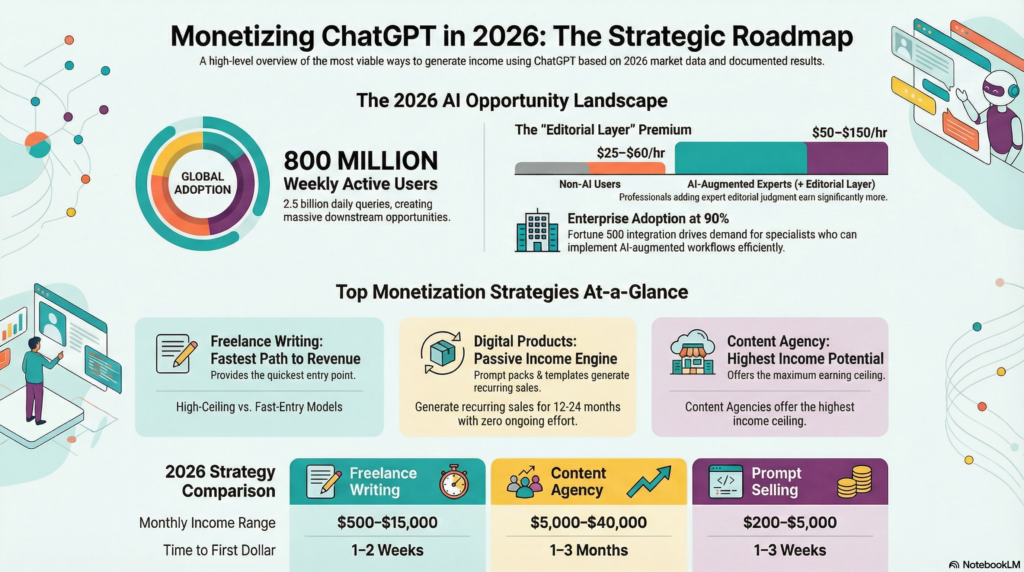
OpenAI’s ChatGPT crossed 800 million weekly active users in 2025, processes 2.5 billion daily queries globally, and powers workflows inside 90% of Fortune 500 companies. OpenAI itself generated $13 billion in revenue in 2025 and is projected to reach $29.4 billion in 2026 — growth that creates enormous downstream opportunities for individuals who know how to turn ChatGPT’s capabilities into real, recurring income.
This guide is different from the generic “10 ways to use ChatGPT” articles flooding the internet. Every strategy here includes a step-by-step execution plan, realistic income ranges backed by documented case studies, the specific ChatGPT prompts and workflows that make each model work, common mistakes that kill income potential, and a realistic assessment of how long it takes to generate your first dollar.
The honest framing: ChatGPT is a force multiplier, not a magic income machine. The people generating $5,000–$30,000/month with ChatGPT are not doing it by simply pressing “generate” — they are applying genuine expertise, editorial judgment, and business acumen on top of AI-accelerated workflows. If you understand that distinction, every strategy in this guide becomes achievable.
At-a-Glance: 10 Ways to Make Money with ChatGPT in 2026
| Strategy | Monthly Income Range | Startup Cost | Skill Level | Time to First Dollar |
|---|---|---|---|---|
| Freelance Writing & Content | $500–$15,000/mo | $0 | Beginner | 1–2 weeks |
| Selling Custom GPTs | $200–$10,000/mo | $20/mo (ChatGPT Plus) | Beginner–Intermediate | 2–4 weeks |
| Prompt Engineering & Selling Prompts | $200–$5,000/mo | $0–$20/mo | Beginner | 1–3 weeks |
| ChatGPT Content Agency | $5,000–$40,000/mo | $200–$2,000 | Intermediate | 1–3 months |
| Niche Blog + AdSense + Affiliate | $500–$15,000/mo | $50–$200 | Beginner–Intermediate | 3–9 months |
| E-commerce Copywriting (Amazon/Shopify) | $1,000–$10,000/mo | $0 | Beginner–Intermediate | 2–4 weeks |
| ChatGPT Business Automation Consulting | $5,000–$50,000/mo | $0–$500 | Intermediate–Advanced | 4–8 weeks |
| Digital Products (Templates, eBooks, Courses) | $500–$30,000/mo | $0–$300 | Beginner–Intermediate | 2–8 weeks |
| YouTube Scripts for Faceless Channels | $300–$8,000/mo | $0–$100 | Beginner | 1–4 months |
| Email Marketing Services | $2,000–$20,000/mo | $0–$100 | Intermediate | 3–6 weeks |
Quick Verdict
- Fastest income (under 14 days): Freelance writing and content services on Upwork or Fiverr. Zero startup cost; your first client can be closed this week if you follow the exact steps in Strategy 1.
- Best for passive income: Selling prompts (PromptBase, Etsy) and digital products (Gumroad). Create once, sell repeatedly. One well-crafted prompt pack can generate sales for 12–24 months.
- Highest income ceiling: ChatGPT content agency and business automation consulting. Both can realistically reach $20,000–$40,000/month within 6–12 months with 3–8 clients on retainer.
- Best long-term compounding: Niche blog monetized through AdSense and affiliate marketing. Slow to build (3–9 months) but produces organic, growing income that compounds as domain authority accumulates.
Methodology: How We Evaluated These Strategies
Each strategy in this guide was evaluated against five criteria based on data from authoritative sources updated through February 2026:
- Income documentation: Real-world case studies and marketplace data (PromptBase, Upwork, Gumroad, Etsy). We cite specific, verifiable income examples — not inflated projections.
- Barrier to entry: Required tools, skills, and time investment. We prioritize strategies accessible to non-engineers.
- Income ceiling and scalability: Can the model grow beyond a single operator? Is recurring revenue possible?
- Market durability: Is this strategy stable against AI tool changes, algorithm updates, and competitive pressure?
- ChatGPT leverage specificity: Does ChatGPT specifically — not just “AI” generically — provide a measurable output advantage? We focus on workflows where GPT-4o provides distinct, demonstrable value.
Primary data sources: OpenAI State of Enterprise AI 2025, Upwork In-Demand Skills 2026, PromptBase marketplace data, and documented freelancer income case studies.
Strategy 1: Freelance Writing and Content Services — The Fastest Entry Point
Why This Works in 2026
Upwork’s 2026 In-Demand Skills report found that AI-related skills demand more than doubled year-over-year. Crucially, this is not replacing content freelancers — it is bifurcating the market. Freelancers using AI to deliver higher volume at higher quality are capturing premium rates; those who resist AI are losing clients to competitors who deliver twice the output in half the time. The market-clearing rate for AI-augmented freelance writers in 2026 is $50–$150/hour for skilled operators — compared to $25–$60/hour for non-AI writers doing equivalent work.
The Exact ChatGPT Workflow That Creates a Rate Premium
The workflow that separates $30/hour writers from $100/hour writers is not the quality of the prompts — it is the editorial layer the writer adds on top. Here is the production system used by top-earning AI-augmented freelancers:
- Brief intake (10 min): Gather client brief, target audience, tone, competitors, keyword targets. The more specific the brief, the better the output. Use this ChatGPT prompt to structure the brief: “You are a senior content strategist. Given this topic: [TOPIC], target audience: [AUDIENCE], and primary keyword: [KEYWORD], generate a detailed content brief including: article angle, key sections, 5 semantic keywords, 3 relevant data points I should research, and the specific pain point this article must solve.”
- Research and sourcing (15 min): Use Perplexity AI or Google to find 3–5 authoritative data points before prompting ChatGPT. Never let ChatGPT invent statistics. Paste the sourced data into the context window and instruct ChatGPT to use only provided data for factual claims.
- Draft generation (5 min): Prompt: “Using only the facts and data I’ve provided above, write a [WORD COUNT]-word article following this brief. Use an authoritative but conversational American English tone. Structure with H2 and H3 headers. Do not fabricate statistics.”
- Editorial pass (20–30 min): This is the step that justifies the premium rate. Rewrite the intro for specificity; remove generic statements; add your client’s brand voice; verify all data against sources; cut filler phrases; and add 1–2 original insights that ChatGPT could not generate — industry perspective, a relevant anecdote, or a counter-intuitive data point.
- SEO optimization (10 min): Run through Surfer SEO or Clearscope to check keyword density, entity coverage, and content score. Adjust as needed.
Total production time per 1,500-word article: 60–75 minutes. Pre-AI, this workflow took 4–6 hours. At $100/hour, one article generates $100–$125 in 75 minutes — the income math is clear.
What Services to Offer and How to Price Them
| Service | Deliverable | Client Price | Production Time | Monthly Revenue (10 clients) |
|---|---|---|---|---|
| SEO Blog Posts | 2,000-word article, optimized | $150–$500/post | 75–90 min | $6,000–$20,000 |
| LinkedIn Content | 8 posts/month + strategy | $500–$1,500/mo | 3–5 hrs/mo | $5,000–$15,000 |
| Email Newsletter | Weekly newsletter, 600–800 words | $300–$800/mo | 2–3 hrs/mo | $3,000–$8,000 |
| Product Descriptions | 10 SKU descriptions | $200–$500 | 1–2 hrs | Variable |
| YouTube Scripts | $150–$400/script | 7–10 min video script | 45–60 min | $3,000–$12,000 |
| Social Media Package | 30 posts/month, all platforms | $800–$2,000/mo | 5–8 hrs/mo | $8,000–$20,000 |
How to Land Your First Client in 7 Days
- Day 1–2: Create 3 portfolio samples. Pick a niche you know (your professional background, hobby, or local market). Write one blog post, one LinkedIn post series (5 posts), and one email sequence (3 emails) using your ChatGPT workflow. Publish the blog post on Medium or your own site.
- Day 3: Create a Upwork profile focused on one specific niche + content type (e.g., “SaaS Blog Writer” or “E-commerce Product Copywriter”). Generic profiles compete on price; niche profiles compete on fit. Use ChatGPT to write your profile bio: “Write a compelling Upwork profile bio for a freelance [NICHE] writer who uses AI tools to deliver premium content 3x faster than traditional writers. 150 words max. Lead with a specific client result.”
- Day 4–5: Send 10 targeted proposals to relevant job postings. Use ChatGPT to personalize each proposal: paste the job description, your bio, and your samples, then prompt: “Write a personalized Upwork proposal for this job that references their specific goals, demonstrates I understand their industry, and shows — not tells — why my AI-augmented process delivers better ROI than a traditional writer.”
- Day 6–7: Follow up on proposals. Accept the first reasonable offer at a slight discount in exchange for a detailed review. This review becomes your most valuable early asset.
Strategy 2: Building and Selling Custom GPTs on the ChatGPT Store
The Opportunity
OpenAI has documented that over 3 million custom GPTs have been created since the feature launched. Usage of structured Custom GPT workflows increased 19x year-to-date within ChatGPT Enterprise. OpenAI’s revenue sharing program rewards builders based on user engagement with their GPTs — the formula is not public, but builders in high-engagement niches report $200–$2,000/month from the program alone, with additional income from direct licensing and consulting built around the GPT.
The income ceiling is not the platform’s revenue share — it is the consulting, course, or SaaS business you build around a successful GPT that earns you authority and clients. A well-built GPT for a specific professional audience (lawyers, real estate agents, HR managers) serves as both a lead generation tool and a demonstration of your AI expertise.
Step-by-Step: How to Build a Profitable Custom GPT
- Choose a specific, underserved professional audience. The most successful GPTs are not “general assistants” — they are purpose-built tools for a specific job. Examples with documented engagement: “Contract Review GPT for Freelancers” (reviews freelance contracts for red flags), “Real Estate Listing Writer” (generates MLS listings from property specs), “HR Policy Explainer” (explains company HR policies in plain English to employees).
- Write a detailed system prompt. This is the entire intellectual property of your GPT. A weak system prompt produces generic output; a detailed one produces consistent, specialized output that users return to. Include: persona definition, specific expertise boundaries, output format templates, what the GPT should refuse, and 3–5 example interactions that show ideal behavior.
- Add knowledge files. Upload PDF guides, industry glossaries, regulatory documents, or style guides that give your GPT domain-specific knowledge beyond what GPT-4o was trained on. A real estate GPT with uploaded local MLS guidelines produces far more useful output than a generic GPT for the same task.
- Test rigorously before publishing. Try 20–30 edge-case prompts. Document where the GPT fails or hallucinates. Refine the system prompt to address each failure mode. Top custom GPTs went through 50–100 iterations before their builders published them.
- Market through communities. Publish in relevant Reddit communities (r/ChatGPT, r/freelance, industry-specific subreddits), LinkedIn posts in professional groups, and ProductHunt. The distribution matters as much as the quality — undiscovered GPTs generate zero income regardless of quality.
Beyond Platform Revenue: The GPT as a Business Asset
The highest-earning Custom GPT builders use their GPT as a funnel into higher-value products: a $99/year membership giving access to their full suite of GPTs, a $497 course teaching their audience how to use AI tools for their profession, or a $2,000/month consulting engagement helping businesses implement the GPT internally. The GPT itself is the marketing tool; the downstream products are the actual business.
Strategy 3: Selling Prompts on PromptBase, Etsy, and Gumroad
The Market Reality
PromptBase, the leading prompt marketplace, is on track to generate over $1 million in annual revenue from prompt sales. Individual sellers have documented earnings of $6,316 (ExpertBeacon case study), $847 in 60 days from 18 prompts (AI in Plain English), and $9,300+ from a single Etsy shop selling AI prompt packs at an average of $3.43 per prompt with 2,715 sales. Individual prompts sell for $3–$50+, with PromptBase taking a 20% marketplace commission.
The passive income appeal is genuine: a well-crafted prompt pack created in an afternoon continues generating sales for 12–24 months with zero ongoing effort beyond occasional updates when model versions change.
What Types of Prompts Sell Best
| Prompt Category | Price Range | Why It Sells | Platform |
|---|---|---|---|
| Business email templates | $5–$15 | Universal demand; professionals pay to save time | PromptBase, Etsy |
| Marketing copy systems | $15–$50 | Businesses pay for output quality, not creation time | Gumroad, PromptBase |
| Industry-specific research | $10–$40 | Niche expertise creates scarcity | PromptBase |
| Resume & cover letter | $5–$20 | High emotional value; clear ROI | Etsy, PromptBase |
| Social media content systems | $10–$30 | Recurring need; agencies buy in bulk | Gumroad |
| Legal document drafting* | $20–$97 | High perceived value; saves hours of work | Gumroad, direct |
| Custom GPT system prompts | $29–$199 | Enables buyers to build their own tools | Gumroad |
*Always include a disclaimer that prompts do not constitute legal advice and all output should be reviewed by a licensed attorney.
How to Create a Prompt That Sells
The anatomy of a high-converting prompt listing:
- Specific title: “Cold Email Generator for B2B SaaS Sales Reps” outperforms “Sales Email Prompt.” Specificity signals that the prompt is tested for a defined use case, not generic.
- Before/after demonstration: Show the difference between a generic ChatGPT output and your optimized prompt’s output side-by-side in your listing images. Buyers need to see the quality difference to justify the price.
- Clear input requirements: Document exactly what information the buyer needs to provide. Prompts that require no setup produce immediate value; prompts that require 30 minutes of configuration get abandoned and returned.
- Include variations: A pack of 5 related prompt variations (formal/casual tone, different industries, long/short format) justifies 3–4x the price of a single prompt and dramatically reduces returns from buyers who find one variation doesn’t fit their exact use case.
- Test with 20+ real outputs before selling: Document what the prompt produces reliably and what it occasionally fails at. Include honest usage notes. Buyers who get what they expected leave positive reviews; buyers who get less leave negative ones that tank future sales.
Scaling to $2,000+/month: The path is volume and compounding reviews. Target 5 new prompt listings per week. After 8 weeks, 40 listings with an average of 3 sales/month each at $7 average = $840/month passive. Review velocity accelerates sales; listings with 10+ reviews consistently outperform new listings by 3–5x. The most successful prompt sellers on PromptBase have 50–200 listings each.
Strategy 4: Running a ChatGPT Content Agency
The Business Model Explained
A ChatGPT content agency uses AI-augmented workflows to deliver content marketing services — blog posts, social media, email, video scripts, ad copy — to businesses on monthly retainers. The fundamental economics: a solo operator charging $2,500/month per client for 8 blog posts (250 per post) and 20 social media posts can serve 8–10 retainer clients simultaneously at 30–40 hours/month total labor, generating $20,000–$25,000/month revenue with margins of 70–80%.
This is not theoretical: documented case studies include a 27-year-old marketer from Austin who built a $250K side hustle (annualized) in six months converting expertise into AI-augmented content products (TechBullion, 2025), and multiple agency owners in online communities who report $15,000–$35,000/month within 12 months of launch.
The Exact Service Stack and Pricing
| Package Name | Monthly Price | What’s Included | Production Hours | Margin |
|---|---|---|---|---|
| Starter | $1,500/mo | 4 blog posts (1,000 words each) + 16 social posts | 8–10 hrs | ~80% |
| Growth | $2,500/mo | 8 blog posts (1,500 words) + 30 social + 1 email newsletter | 14–18 hrs | ~75% |
| Authority | $4,000/mo | 12 long-form posts (2,000 words) + 50 social + 4 emails + monthly strategy call | 22–28 hrs | ~72% |
| Full-Service | $6,000+/mo | Everything above + video scripts + ad copy + reporting | 32–40 hrs | ~68% |
The ChatGPT Workflow Behind Each Package
For blog posts (1,500-word SEO post in 60 minutes):
- Keyword brief (5 min): Use Ahrefs or Semrush to pull the target keyword’s top 10 ranking articles. Identify what they all cover (table stakes) and what 2–3 angles are missing (your differentiation). Paste this competitive gap analysis into ChatGPT.
- Outline generation (3 min): Prompt: “I’m writing an SEO article targeting [KEYWORD] for [AUDIENCE]. Here’s what the top 10 competing articles cover: [LIST]. Generate an outline that covers the same table-stakes topics but adds these unique angles that competitors miss: [GAPS]. Include a controversial opening hook, a data-driven section, and a practical how-to section.”
- Section-by-section drafting (15 min): Draft each H2 section separately, not the whole article at once. This produces more focused, coherent sections and prevents the “generic middle section” problem that plagues full-article ChatGPT outputs.
- Editorial pass (30 min): Rewrite the intro; verify all stats; add client brand voice; cut filler; add 1–2 original insights. This pass is what separates $50 commodity content from $250 premium content.
- SEO pass (7 min): Check against target keyword, add internal links, optimize title tag and meta description.
For social media (30 posts in 2 hours): Create a “content ingredients” document with the client’s brand voice, audience pain points, core value propositions, and 10 content categories (educational, inspirational, promotional, behind-the-scenes, etc.). Prompt ChatGPT with the full ingredients document: “Generate 6 social media posts for each of these 5 content categories. For each post: one version for LinkedIn (professional, 200 words), one for Instagram (casual, 80 words, with emoji). Use only the brand voice and messaging from the ingredients document.” This single prompt generates 60 draft posts in 90 seconds. 2 hours of editing produces 30 polished, ready-to-schedule posts.
Client Acquisition: How to Get Your First 3 Clients
- Warm outreach first. Message 20 businesses in your immediate network — former colleagues, local businesses you patronize, LinkedIn connections — and offer a free audit of their content. The audit uses ChatGPT: prompt it to analyze their website copy, latest 5 blog posts, and social media bio for gaps, tone inconsistencies, and SEO opportunities. The audit takes 30 minutes; it demonstrates immediate value and creates a natural sales conversation.
- Niche down immediately. “Content agency” is a commodity category. “Content agency for SaaS companies” or “Content agency for healthcare practices” is a specialty that commands 2x the rates and dramatically shorter sales cycles because clients immediately recognize you understand their industry.
- Build a one-post proof of concept. Identify a prospect’s best-performing blog post (use Ahrefs Site Explorer or simply check their most-shared content). Rewrite it using your ChatGPT workflow — improved structure, better SEO, stronger hook. Send them the rewrite unprompted with a 2-paragraph note explaining what you changed and why. Conversion rates on this approach are documented at 15–25% by agency owners using it.
Strategy 5: Niche Blog Monetized with AdSense and Affiliate Marketing
The Model and the Realistic Timeline
The niche blog model uses ChatGPT to produce large volumes of targeted, SEO-optimized content on a specific topic, monetized through Google AdSense (display advertising revenue) and affiliate commissions (earning 5–40% of referred product sales). The model has a slower ramp (3–9 months to meaningful revenue) but produces compounding, passive income that grows as domain authority builds.
The honest caveat: Google’s 2024–2025 Helpful Content updates penalized low-quality AI-generated content heavily. Sites publishing hundreds of AI articles without genuine editorial value have lost 80–95% of their organic traffic. The successful niche blog model in 2026 is not “publish 500 AI articles” — it is “publish 50–100 deeply researched, editorially polished articles on a topic where you have genuine expertise or research capability, with ChatGPT as the production accelerator.” Quality beats volume every time. Source: Google Search Central — Helpful Content System.
The ChatGPT Niche Blog Workflow
- Niche selection (critical): Use ChatGPT + Google Keyword Planner to identify a niche with: (a) monthly search volume of 10,000–500,000 for head terms, (b) commercial intent (products or services being purchased), (c) limited competition from massive authority sites (avoid niches where NerdWallet, WebMD, or Wikipedia dominate every SERP), and (d) an audience you genuinely understand. Prompt: “Suggest 10 niche blog topics at the intersection of [YOUR INTERESTS/EXPERTISE]. For each, estimate: monthly search demand, affiliate product availability, and whether massive authority sites dominate the top 10 results.”
- Content calendar generation: For each target keyword cluster, prompt: “Generate a 90-day content calendar for a blog targeting [NICHE AUDIENCE]. Include: 2 pillar articles per month (3,000+ words), 4 cluster articles per week (1,200–1,800 words), and 2 comparison/review posts per month (commercial intent). Format as a table with: target keyword, article type, estimated monthly search volume, and monetization method (AdSense vs. affiliate).”
- Article production: Apply the same ChatGPT workflow from Strategy 1 (research → outline → draft → editorial pass → SEO pass). Target a minimum of 4 articles per week in the first 90 days to accelerate domain authority accumulation.
- Monetization setup: Install Google AdSense on articles with informational intent. Apply to relevant affiliate programs (Amazon Associates for product reviews; ShareASale, CJ Affiliate, or Impact for software and services) for commercial-intent articles. The highest-earning niche blogs in 2026 generate 60–70% of revenue from affiliate commissions and 30–40% from AdSense.
Strategy 6: E-commerce Copywriting — Amazon Listings and Shopify Product Pages
Why This Is a Hidden Gem
Amazon sellers and Shopify merchants represent one of the most underpenetrated markets for AI-augmented copywriting services. An Amazon listing with optimized title, bullet points, A+ content, and backend keywords directly determines a product’s conversion rate and organic ranking. A 1-percentage-point improvement in conversion rate on a product doing $100,000/month in revenue means $1,000/month in additional profit — making a $500 listing optimization an obvious value proposition for sellers.
Most Amazon sellers are product operators, not copywriters. They know their product deeply but cannot articulate its benefits in the specific, keyword-rich format that Amazon’s algorithm and buyer psychology both require. ChatGPT, given the right inputs, produces precisely structured Amazon copy that a non-writer seller would struggle to produce independently.
The ChatGPT Amazon Listing Workflow
- Competitive research (15 min): Pull the top 5 competitor listings for your client’s product category. Paste all 5 titles and bullet points into ChatGPT. Prompt: “Analyze these 5 Amazon listings for [PRODUCT CATEGORY]. Identify: (1) the 10 most repeated keywords across all listings, (2) the top 3 unique selling points that appear only in 1–2 listings (potential differentiators), (3) buyer objections implied by the specific language used, and (4) emotional triggers that appear in the highest-rated listings.”
- Client product brief: Gather from the client: product specs, primary use cases, target customer, most common customer review themes (both positive and negative), and 3 key differentiators vs. competitors.
- Title generation: Prompt: “Write 5 Amazon title variations for [PRODUCT] targeting these primary keywords: [LIST]. Each title must be under 200 characters, include the brand name, lead with the primary keyword, and follow Amazon’s title style guidelines. Prioritize conversion over creativity.”
- Bullet points: Prompt: “Write 5 Amazon bullet points for [PRODUCT]. Each bullet must: start with a benefit in caps (not a feature), be 150–200 characters, include one secondary keyword naturally, and address one specific buyer objection or hesitation. Use these confirmed buyer pain points from reviews: [LIST].”
- Editorial pass (20 min): Remove any ChatGPT clichés (“game-changing,” “revolutionary”), verify keyword placement, and ensure Amazon’s prohibited content guidelines are met.
Pricing: Full listing optimization (title + 5 bullets + product description + A+ content outline): $300–$800 per ASIN. For sellers with 10–50 SKUs, a monthly retainer of $1,500–$5,000 covers ongoing listing management, A/B test copy, and new product launches.
Strategy 7: ChatGPT Business Automation Consulting
The Opportunity in the Implementation Gap
McKinsey’s State of AI 2025 report found that 88% of companies use AI in at least one function — but only 5% report AI improving their bottom line at the enterprise level. This gap between adoption and results is the consulting opportunity. Business owners and managers know ChatGPT exists; they do not know how to systematically implement it in ways that produce measurable time or cost savings. That knowledge is the product.
A workflow automation consultant who identifies that a 10-person marketing team spends 12 hours/week manually writing internal reports — and builds a ChatGPT-powered system that produces those reports in 45 minutes — delivers 11.25 hours/week of labor savings. At $60/hour burdened labor cost, that is $675/week, $2,700/month, $32,400/year in savings. A consulting fee of $5,000–$10,000 to design and implement that system is an obvious ROI positive decision for the client.
How to Structure a Consulting Engagement
| Engagement Phase | What You Deliver | Typical Fee | Duration |
|---|---|---|---|
| AI Readiness Audit | Map all workflows; identify top 5 automation candidates; quantify time/cost of each | $1,500–$5,000 | 1–2 weeks |
| Proof of Concept | Build one high-impact ChatGPT workflow; document time saved; present ROI | $3,000–$8,000 | 2–3 weeks |
| Full Implementation | Build all prioritized automations; train team; document SOPs | $10,000–$50,000 | 4–12 weeks |
| Ongoing Retainer | Monthly optimization; add new workflows; update prompts for model changes | $2,000–$8,000/mo | Ongoing |
The Most Valuable ChatGPT Automation Workflows to Offer
These workflow categories generate the clearest, most documentable ROI for clients — making them the easiest sales:
- Customer support FAQ automation: Build a ChatGPT system that drafts responses to the 50 most common customer service inquiries. Reduces tier-1 support tickets by 40–60%. Applicable to any business with an e-commerce or SaaS component.
- Internal report generation: Replace manually assembled weekly/monthly reports with a ChatGPT workflow that ingests data from spreadsheets and generates formatted reports automatically. Saves 5–15 hours/month per department.
- Sales email personalization at scale: Build a system where a sales rep enters 5 facts about a prospect, and ChatGPT generates a fully personalized cold email that reads nothing like a template. Documented to improve reply rates 2–4x in B2B sales contexts.
- Job description and HR documentation: HR teams spend 3–8 hours writing each job description. A well-built ChatGPT workflow with the company’s EVP (employee value proposition) and role-specific inputs produces first-draft job descriptions in 5 minutes that require 20 minutes of editing.
- Proposal and RFP response drafting: For professional services firms (law, accounting, consulting, architecture), proposal writing can consume 20–40 hours per pitch. A ChatGPT system trained on the firm’s past proposals, service descriptions, and case studies can produce 80% of a proposal draft in 2 hours.
Strategy 8: Digital Products — Templates, eBooks, and Courses
Why Digital Products Are a Top-Tier ChatGPT Income Model
Digital products have zero marginal cost — the 1,000th sale costs the same to fulfill as the 1st. ChatGPT makes the creation phase of digital products dramatically faster and more accessible, collapsing the production time for an eBook from weeks to days, a course from months to weeks, and a template pack from days to hours.
The documented income potential is significant: a 27-year-old marketer built a $250K/year income stream (TechBullion, 2025) by converting scattered Notion notes into templated products using ChatGPT — with zero ad spend, zero team, and zero manufacturing overhead. The key was applying genuine professional expertise to determine what to build, then using ChatGPT to execute the production rapidly.
The Three Most Profitable Digital Product Types with ChatGPT
1. Professional Templates ($9–$97): Notion dashboards, Google Sheets automations, Airtable bases, Canva presentation templates, and Microsoft Word document templates with AI-generated copy already included. The target buyer is a professional who needs the tool immediately and has a “buy vs. build” decision to make. At $47 per template and 100 sales/month, this is $4,700/month in passive income from a product that took 8 hours to create. Platforms: Gumroad, Etsy, Notion Template Gallery.
2. Niche eBooks ($7–$47): The key is specificity. “The Complete Guide to Remote Work Productivity” competes with 10,000 free articles. “The Freelance Video Editor’s ChatGPT Playbook: 15 Workflows That Save 10 Hours Per Week” serves a specific audience with a specific problem and has essentially no competition. Use ChatGPT to draft the content, add your personal experience and case studies, hire a freelance designer on Fiverr for the PDF layout ($50–$150), and publish on Gumroad. Realistic income: $500–$5,000/month for a well-positioned, professionally presented niche eBook.
3. Online Courses ($197–$997): The highest-income digital product type. Use ChatGPT to create the entire course curriculum, slide outlines, lesson scripts, worksheets, and quiz questions — then record video lessons. On platforms like Udemy, Teachable, or Kajabi, courses with genuine practical value in growing niches (AI tools for specific professions, marketing automation, productivity systems) can generate $2,000–$20,000/month. Prompt: “Design a 6-module online course curriculum for [TARGET AUDIENCE] on [TOPIC]. For each module: course objectives, 4–6 lessons, a practical exercise, and a quiz with 5 questions. The course should take students from [STARTING POINT] to [TRANSFORMATION].”
Strategy 9: YouTube Scripts for Faceless Channels
The Model and Income Potential
Faceless YouTube channels — channels where the creator never appears on camera, using AI voiceover and stock footage instead — have become one of the most accessible YouTube monetization models precisely because ChatGPT solves the most time-consuming component: scripting. A well-researched, well-scripted 10-minute YouTube video on a high-RPM topic (personal finance, investing, technology, health) can generate $15–$50 per 1,000 views from YouTube AdSense — and videos on evergreen topics continue accumulating views for years.
The full production stack: ChatGPT (script) + ElevenLabs (AI voiceover, $5–$22/month) + Pictory or InVideo AI (auto-generates video from script, $19–$49/month) + YouTube automation. Total tool cost: $40–$80/month. A channel reaching 10,000 subscribers with 50,000 monthly views and a $20 RPM generates $1,000/month — requiring approximately 4–6 hours of content production per week.
The ChatGPT YouTube Script Workflow
- Topic research: Use TubeBuddy or VidIQ to find keywords with high search volume and low competition. Target topics where the top 5 results have under 100,000 views — the sweet spot where you can rank without competing against massive channels.
- Script prompt: “Write a 1,200-word YouTube script on [TOPIC] for an audience of [AUDIENCE]. Structure: (1) Hook — open with the most surprising or counterintuitive fact about this topic, do not start with ‘Welcome back’; (2) Problem — establish why this matters to the viewer in 2–3 sentences; (3) Promise — what they will know by the end; (4) Main content — 5 clearly numbered sections with specific, actionable information; (5) Recap — summarize the 3 most important takeaways in 30 seconds; (6) CTA — encourage subscribe + specific related video. Use conversational American English. Vary sentence length for natural speech rhythm.”
- Editorial pass: Remove phrases that sound unnatural spoken aloud (“Furthermore,” “It is worth noting that”). Add pauses for emphasis. Verify all statistics with a quick Google search before using them.
- Voiceover production (ElevenLabs): Paste the script into ElevenLabs, select a natural-sounding voice that matches your channel’s persona, and generate the audio. Total time: 3 minutes.
- Video assembly (Pictory or InVideo AI): Paste the script; the tool auto-selects relevant stock footage and assembles a video with the voiceover. Manual adjustments for B-roll quality: 20–30 minutes.
Strategy 10: Email Marketing Services
Why Email Marketing Is the Highest-ROI Service You Can Offer
Email marketing generates $36 for every $1 spent — the highest ROI of any digital marketing channel (Litmus Email Marketing ROI Report, 2025). Yet most small businesses have a neglected email list, no consistent sending schedule, and copy that sounds generic and mechanical. This gap is a direct service opportunity for ChatGPT-augmented email marketers.
The service model: manage a client’s entire email marketing function — list strategy, welcome sequences, weekly newsletters, promotional campaigns, and A/B test copy — for a monthly retainer of $1,500–$5,000. With ChatGPT handling first-draft production and you providing strategy and editorial judgment, you can realistically manage 5–8 clients simultaneously at 8–15 hours/month per client, generating $7,500–$40,000/month in revenue.
The ChatGPT Email Marketing Workflow
For welcome sequences (5-email automation, 90-minute production):
- Gather client’s brand voice, core value propositions, most common customer objections, and the specific action they want new subscribers to take (purchase, book a call, start a trial).
- Prompt: “Write a 5-email welcome sequence for [BUSINESS TYPE]. Email 1: Deliver the lead magnet + set expectations (day 0). Email 2: Tell the brand’s origin story — why they started and what they believe (day 2). Email 3: Address the #1 objection buyers have before purchasing: [OBJECTION] (day 4). Email 4: Social proof — a specific customer success story with measurable outcome (day 6). Email 5: Soft CTA — invite them to [DESIRED ACTION] with a no-pressure framing (day 8). Each email: subject line + preview text + body copy. Brand voice: [DESCRIBE]. Average length: 200–300 words.”
- Editorial pass: Personalize the storytelling in Email 2; verify the customer story in Email 4 is real (obtain from client); adjust the CTA in Email 5 to match the client’s current offer precisely.
For weekly newsletters (30-minute production): Create a “newsletter template” system once per client. Define the sections (one insight, one tool recommendation, one question for the reader, one CTA). Use ChatGPT each week to draft the content by providing the week’s topic and 2–3 relevant facts or ideas. Total prompt-to-draft time: 3 minutes. Editorial polish: 25 minutes. This is the core of what makes email marketing services viable at scale — the template-first approach makes weekly production fast enough to serve 8+ clients without burnout.
Frequently Asked Questions
Do I need a ChatGPT Plus subscription to make money with ChatGPT?
ChatGPT Free (GPT-4o mini) is sufficient for most beginner strategies — freelance writing, prompt selling, and basic email marketing. ChatGPT Plus ($20/month) unlocks GPT-4o (significantly better for complex, nuanced writing), Custom GPT creation, and advanced data analysis capabilities. For the content agency, automation consulting, and Custom GPT strategies, the $20/month investment in Plus is essential and pays for itself with a single hour of client work.
How do I make sure my ChatGPT-produced content is not detected as AI?
The goal is not to “pass” AI detection — it is to produce genuinely high-quality content that adds real value. Google has stated explicitly that it evaluates content on helpfulness, expertise, and accuracy, not on the tool used to write it. The editorial workflow described in Strategy 1 (human research → AI draft → expert editorial pass) produces content that reflects genuine expertise and cannot be meaningfully distinguished from human-written content because a significant portion of it is human-written. Never publish raw ChatGPT output without meaningful editorial revision. That is both the ethical standard and the practical quality standard.
Which strategy should a complete beginner start with?
Strategy 1 (freelance writing) if you have a professional background in any field. Strategy 3 (selling prompts) if you want the fastest passive income experiment with the lowest risk. Strategy 5 (niche blog) if you want a long-term, compounding income stream and are willing to invest 6–9 months before seeing meaningful returns. In all cases: specialize immediately. Pick one niche, one strategy, and one platform. Generalists struggle; specialists thrive in the current AI income market.
What is the biggest mistake beginners make with these strategies?
Publishing or delivering unedited ChatGPT output. ChatGPT’s first draft is a starting point, not a finished product. It generates average, aggregated output based on what it has seen across the internet — which means its default output is exactly as distinctive as the median piece of writing online (not very). The income premium in every strategy here comes from the editorial layer that transforms average output into expert output. Every practitioner generating $5,000+/month with ChatGPT adds substantial human expertise before anything reaches a client, a buyer, or a search engine.
How should I handle clients who ask if I use AI?
Be transparent and confident. The honest positioning: “I use AI tools as production infrastructure to deliver faster, more consistent output — the same way a professional photographer uses a digital camera instead of a film camera. The expertise, strategy, and editorial judgment are mine; AI accelerates the execution.” Clients who cannot accept this answer are generally looking for labor arbitrage at low rates — not the high-value, expert-positioned services that generate $100–$300/hour equivalent rates. Transparency filters for better clients.
Bottom Line: ChatGPT as a Professional Leverage Tool
ChatGPT crossed 800 million weekly active users and powers 90% of Fortune 500 companies’ AI workflows. The income opportunities are real, documented, and accessible — but they require the same ingredient that all durable income streams require: genuine expertise applied consistently over time.
The practitioners generating $10,000–$40,000/month with ChatGPT are not finding exploits or workarounds. They are delivering real value — better content, faster automation, clearer communication, more consistent systems — to clients and customers who would otherwise spend more time and money producing inferior results without them. ChatGPT is the leverage; your expertise is the foundation.
Choose one strategy from this guide. Commit to it for 90 days. Apply the specific workflows described — not a generic version, the specific steps. Collect feedback, iterate, and raise your rates as your output quality and client results compound.
Start here: ChatGPT | Upwork | PromptBase | Gumroad | Fiverr
Earnings disclaimer: Income figures in this article reflect documented case studies and market data. Individual results will vary based on skills, time invested, niche selection, and effort. ChatGPT and all mentioned platforms are independent products; we are not affiliated with OpenAI. This article is for informational purposes only.

Author: Iovanny Olguín Ávila
Computer Systems Engineer with an MSc in Computer Science. I apply quantitative analysis and data-driven methodologies to evaluate financial instruments, investment vehicles, and emerging technologies. My technical background allows me to cut through marketing language and analyze the actual mechanics of financial products — from HELOC structures to Medicare Advantage plan design to business credit card reward algorithms.