
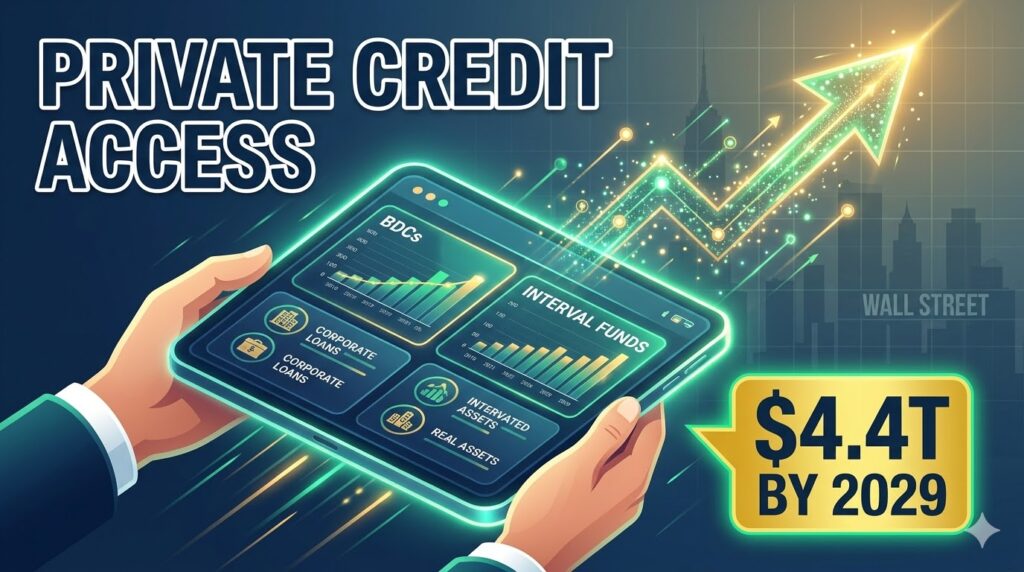

For decades, private credit — direct loans to middle-market companies, real estate debt, infrastructure financing, and specialty finance — was the exclusive domain of institutional investors: pension funds, endowments, sovereign wealth funds, and the ultra-wealthy. Minimum investments of $5 million to $10 million, 10-year capital lockups, and complex regulatory exemptions put private credit firmly out of reach for everyday investors. That exclusivity is rapidly ending. In 2026, retail investors can access private credit funds with minimums as low as $2,500–$25,000, through semi-liquid structures that offer quarterly redemption windows and monthly NAV reporting.
The democratization of private markets is not a niche trend — it is, according to HedgeCo Insights, “the defining investment story of the decade.” Major asset managers — Blackstone, Apollo Global Management, KKR, Ares Management, and Blue Owl Capital — are aggressively expanding into retail channels, targeting the estimated $60 trillion held by individual investors globally. Evergreen fund assets are projected to reach $4.4 trillion by 2029, per Mondaq. But the opportunity comes with real risks — and 2026 has seen the first significant stress tests of these new retail-accessible structures.
This guide covers the full landscape of private credit and alternative investments for retail investors in 2026: what private credit is, how the major vehicle types (BDCs, interval funds, tender offer funds, evergreen vehicles) work, real returns and risks, the liquidity stress events of 2025–2026, how to evaluate and size a position in your portfolio, and a due diligence framework for comparing specific funds.
At-a-Glance: Private Credit Vehicle Comparison 2026
| Vehicle Type | Minimum Investment | Liquidity | Expected Yield | Key Managers | Risk Level |
|---|---|---|---|---|---|
| Business Development Company (BDC) | $500–$5,000 (public); $25K (non-traded) | Daily (listed BDCs); Quarterly (non-traded) | 8–12% dividend yield | Ares Capital, FS Investment, Prospect Capital | Medium-High |
| Interval Fund | $2,500–$10,000 | Quarterly (typically 5% of NAV) | 6–10% | Griffin Capital, Versus Capital, Griffin-American | Medium |
| Tender Offer Fund | $25,000–$100,000 | Monthly or quarterly (at manager discretion) | 7–11% | Blackstone BCRED, Blue Owl BDC, KKR Credit | Medium-High |
| Evergreen / Perpetual Fund | $25,000–$250,000 | Quarterly (gated) | 8–13% | Apollo Aligned Alternatives, Ares ASIF | High |
| Tokenized Private Credit | $1,000–$10,000 | Secondary market (limited) | 7–12% | Centrifuge, Figure, Maple Finance | High |
| Private Credit ETF | $100+ (per share) | Daily (exchange-traded) | 5–8% | PCMF, BIZD, KBWD | Medium |
Methodology: How We Evaluated Private Credit Vehicles
We evaluated private credit investment vehicles across six criteria:
| Criterion | Weight | What We Measured |
|---|---|---|
| Yield / Return potential | 25% | Trailing 12-month distribution yield; NAV total return including capital appreciation/depreciation |
| Liquidity terms | 25% | Redemption frequency, notice period, gate provisions, and historical redemption fulfillment |
| Fee structure | 20% | Management fee, incentive fee, administrative fees, and any load or redemption charges |
| Portfolio transparency | 15% | Frequency and detail of holdings disclosure; loan-level data availability |
| Manager track record | 10% | Years managing private credit; institutional AUM; default and loss rates |
| Minimum investment | 5% | Accessibility for retail investors; accredited vs. non-accredited requirements |
Sources: HedgeCo Insights — Retailization of Private Markets; Freshfields — Private Capital Courts Mom and Pop; Markets Insider — Retail Investor Private Credit Risks; SEC filings; fund prospectuses and annual reports as of Q4 2025. All performance data from publicly available sources; past performance does not guarantee future results.
Section 1: What Is Private Credit and Why Does It Matter in 2026?
Private credit refers to debt financing provided directly by non-bank lenders — primarily private credit funds managed by asset managers like Ares, Apollo, and Blackstone — to companies that either cannot access, or prefer to avoid, public bond markets and traditional bank loans. The $3 trillion private credit industry has grown explosively since 2010, driven by bank regulation (Basel III and IV limiting bank balance sheets), the emergence of large direct lending funds, and demand from middle-market companies for flexible financing. JPMorgan CEO Jamie Dimon warned in March 2026 that mounting problems in private credit — including bankruptcies of private-credit-backed companies — suggest deeper stress ahead.
Why Private Credit Outperformed Public Bonds (2015–2024)
Private credit delivered superior risk-adjusted returns to institutional investors for most of the past decade because:
- Illiquidity premium: Investors accept lower liquidity in exchange for higher yields — typically 150–300 basis points above comparable public market leveraged loans or high-yield bonds.
- Floating rate structure: Most private credit loans are floating rate (SOFR + spread), meaning yields rise with interest rates — unlike fixed-rate bonds that lose value when rates rise. This made private credit a strong performer in 2022–2024’s rising rate environment.
- Covenant protection: Private credit loans typically include maintenance covenants (quarterly testing of leverage ratios, interest coverage) that public market bonds lack. Covenants provide early warning and work-out leverage when borrower performance deteriorates.
- Senior secured position: Most direct lending is senior secured — lenders have first claim on borrower assets in default. Recovery rates on senior secured private credit loans average 60–80% historically, per Preqin data.
The 2026 Private Credit Landscape
The landscape has shifted in 2026. After years of rapid expansion, the private credit industry faces its first significant credit cycle stress:
- Private-credit-backed company bankruptcies rose 40% in 2025 versus 2024, per S&P LCD.
- Blackstone’s BCRED (Blackstone Private Credit Fund) received $3.8 billion in redemption requests — triggering partial gates that limited actual redemptions to 5% of NAV per quarter.
- Blue Owl Capital permanently halted redemptions from its Capital Corp II fund in February 2026, citing portfolio management needs.
- Spreads on middle-market direct loans narrowed from 600–700 bps over SOFR in 2022 to 450–550 bps in late 2025 as competition among lenders intensified — compressing the illiquidity premium that justified the asset class.
None of these developments make private credit uninvestable — but they do illustrate why due diligence, liquidity assessment, and portfolio sizing are critical. A 5–15% allocation to private credit in a diversified portfolio is reasonable for many investors; a 50%+ allocation in private credit alone is not.
Section 2: Business Development Companies (BDCs) — The Public Market Entry Point
Business Development Companies are SEC-regulated investment companies (under the Investment Company Act of 1940) that lend to or invest in middle-market U.S. companies — typically businesses with $10 million to $1 billion in revenue that cannot efficiently access public debt markets. BDCs are the most accessible form of private credit for retail investors because most are publicly traded on major stock exchanges (NYSE, Nasdaq).
BDC Structural Requirements
- Must invest at least 70% of assets in “qualifying assets” (primarily loans to private U.S. companies).
- Must distribute at least 90% of investment income as dividends (similar to REITs) — qualifying for pass-through tax treatment.
- Regulated leverage: maximum 1:1 debt-to-equity (2:1 in some cases post-2018 Small Business Credit Availability Act).
- Quarterly NAV reporting and annual audited financials required by SEC.
- Subject to SEC oversight, disclosure requirements, and board independence standards.
Top Listed BDCs: Performance Comparison 2025
| BDC | Ticker | Total Assets | 12-Mo Distribution Yield | NAV Per Share (Q4 2025) | Leverage Ratio | Rating |
|---|---|---|---|---|---|---|
| Ares Capital Corporation | ARCC | $22.6B | 9.4% | $19.52 | 1.15x | ★★★★★ |
| FS KKR Capital Corp | FSK | $15.2B | 13.8% | $23.44 | 1.21x | ★★★★☆ |
| Blue Owl Capital Corporation | OBDC | $18.1B | 10.2% | $15.37 | 1.10x | ★★★★☆ |
| Prospect Capital Corp | PSEC | $7.8B | 11.1% | $9.18 | 0.97x | ★★★☆☆ |
| Main Street Capital | MAIN | $5.1B | 6.4% (+ special dividends) | $30.44 | 0.80x | ★★★★★ |
| Golub Capital BDC | GBDC | $4.9B | 9.8% | $15.28 | 1.22x | ★★★★☆ |
Data from SEC filings and fund reports as of Q4 2025. Past performance does not guarantee future results. Yields fluctuate with base rates and portfolio performance.
ARCC (Ares Capital Corporation) is widely considered the gold standard of BDCs — the largest, most diversified, and best-performing over the full 20-year history of the BDC space. Its 9.4% yield, combined with a stable NAV and conservative leverage, earns a 5-star rating in our evaluation. MAIN (Main Street Capital) is distinctive for its internally managed structure (lower fees), lower leverage, and exceptional long-term track record including regular special dividends. For income-focused investors, ARCC and MAIN represent the most proven BDC options.
Non-Traded BDCs: Higher Yields, Less Liquidity
Non-traded BDCs are SEC-registered but not listed on public exchanges. They offer higher potential yields (12–15%) due to greater portfolio flexibility and absence of market pricing pressure, but significantly less liquidity. Redemptions are available quarterly at NAV, subject to gates. Examples include Blackstone Private Credit Fund (BCRED), Blue Owl BDC, and KKR Real Estate Finance Trust. Minimums typically $25,000–$100,000 and broker-sold with 3.5–5% front-end loads. These are appropriate for accredited investors with a 3–5+ year investment horizon and a clear understanding of the redemption constraints demonstrated in 2025–2026.
Section 3: Interval Funds — The Middle Ground
Interval funds are SEC-registered closed-end funds that offer to repurchase a specified percentage of shares at regular intervals (typically quarterly) — hence the name. Unlike open-end mutual funds, they are not redeemable on any business day; unlike traditional closed-end funds, they are not traded on an exchange. This structure gives managers the ability to invest in truly illiquid assets (private loans, real estate debt, specialty finance) while offering regular (if limited) liquidity to investors.
How Interval Fund Redemptions Work
- The fund announces an offer to repurchase a specified percentage of outstanding shares — typically 5% of NAV per quarter (the minimum required by SEC rules).
- Shareholders submit redemption requests during the offer period (usually 3–4 weeks).
- If requests exceed the offer amount (oversubscribed), each shareholder receives a pro-rata portion of the 5% repurchase offer — meaning a shareholder wanting to redeem 100% of their position may receive only partial redemption.
- The remaining position stays invested until the next quarterly offer.
For retail investors accustomed to daily mutual fund liquidity, the implication is critical: do not invest money you may need quickly in an interval fund. The 5% quarterly cap means full exit from a large position could take 5+ years in a worst-case scenario (though typical scenarios with partial redemption fulfillment are faster).
Leading Interval Funds for Private Credit Exposure (2026)
| Fund | Manager | 12-Mo Return | Distribution Yield | Min. Investment | Focus Area |
|---|---|---|---|---|---|
| Griffin Capital Essential Asset REIT II | Griffin Capital | 7.8% | 6.5% | $2,500 | Commercial real estate debt |
| Versus Capital Multi-Manager Real Assets | Versus Capital | 9.2% | 8.1% | $50,000 | Infrastructure + real estate debt |
| KCAP Financial | KCAP | 8.4% | 7.9% | $10,000 | Middle-market direct lending |
| Blackstone Real Estate Income Trust (BREIT) | Blackstone | 10.1% | 4.5% | $2,500 | Diversified real estate (debt + equity) |
| Blue Owl Real Estate Net Lease Trust | Blue Owl | 8.9% | 6.8% | $10,000 | Net lease real estate |
Section 4: Risks Investors Must Understand — The 2026 Reality Check
Liquidity Risk: The Primary Danger for Retail Investors
The most significant risk in private credit for retail investors is liquidity mismatch: the fund holds illiquid assets (loans that cannot be quickly sold) while offering quarterly redemption windows to investors. In normal markets, this works because redemptions are modest and manageable. In stress periods — like late 2025 — redemption requests can spike, forcing managers to choose between honoring redemptions (by selling assets at distressed prices or drawing credit facilities) or invoking gates (restricting redemptions).
Real 2025–2026 examples:
- Blackstone BCRED: Received redemption requests totaling $3.8 billion — 38%+ of NAV at the time. Invoked the 5% quarterly cap, fulfilling only a fraction of requests. Investors who needed liquidity were stuck.
- Blue Owl Capital Corp II: Permanently halted redemptions in February 2026. As of March 2026, investors have no path to liquidity. Per Markets Insider, fears about retail investor participation in private credit are “playing out.”
The lesson: treat private credit as a 5–10 year illiquid commitment even when quarterly redemption windows exist on paper. Never invest more than you can afford to have locked up.
Credit Risk: Default and Loss Rates Rising
Private credit default rates rose in 2025 as the full impact of higher interest rates (floating rate loans with SOFR at 4.25–4.75%) hit over-leveraged borrowers. Key data points:
- Middle-market direct lending default rate: approximately 3.5–4.0% in 2025, up from 1.5–2.0% in 2023, per Moody’s Analytics.
- Recovery rates on defaulted private credit loans: approximately 50–65% in recent stress scenarios — below the historical 65–80% average, as many borrowers are more leveraged than in prior cycles.
- Non-accrual rates on listed BDCs averaged 3.8% of portfolio at cost in Q3 2025, per Wells Fargo Securities BDC research.
Valuation Risk: The Mark-to-Model Problem
Private credit portfolios are valued at “fair value” as determined by fund managers and their independent valuation agents — not by market prices (since private loans don’t trade). This creates the risk that NAV may be overstated relative to what loans would actually fetch in a forced sale. Indicators to watch: increasing PIK (payment-in-kind) loans in the portfolio (where borrowers pay interest by issuing new debt rather than cash — a sign of stress), widening non-accrual rates, and declining interest coverage ratios of portfolio companies.
Fee Risk: Understanding the True Cost of Private Credit
| Fee Type | Typical Range | Impact on Net Return |
|---|---|---|
| Management fee | 1.0–1.75% of assets annually | Reduces gross yield by 1–1.75 points |
| Incentive fee (income) | 20% of income above 7% hurdle | Reduces excess returns by 20% |
| Incentive fee (capital gains) | 20% of net realized gains | Reduces total return in good years |
| Administration fee | 0.1–0.4% of assets | Modest but additive |
| Front-end load (broker-sold) | 0–5.5% of investment | One-time reduction to invested capital |
| Redemption fee | 0–2% of redeemed amount | Discourages short-term redemptions |
At a 12% gross yield, a fund with a 1.5% management fee, 20% incentive fee (after 7% hurdle), and 0.3% admin fee may deliver approximately 8.5–9.5% net yield to investors. Compare net-of-fee returns across funds, not gross yields.
Section 5: Private Credit ETFs — Liquid Alternatives
For investors wanting private credit exposure without the illiquidity of interval funds or BDCs, several exchange-traded funds provide daily liquidity access to credit markets:
| ETF | Ticker | Expense Ratio | Yield | Holdings | True Private Credit Exposure? |
|---|---|---|---|---|---|
| VanEck BDC Income ETF | BIZD | 10.07% (includes BDC fees) | 10.5% | 25 listed BDCs | Indirect — through listed BDCs |
| Invesco Senior Loan ETF | BKLN | 0.65% | 7.2% | 200+ leveraged loans | No — public syndicated loans |
| BlackRock TCP Capital ETF (formerly PCMF) | PCMF | 0.97% | 8.1% | 80 leveraged loans + BDCs | Partial — mix |
| ProShares Morningstar Senior Loan ETF | FLRT | 0.70% | 7.4% | 125+ syndicated loans | No — public market |
The honest answer: true private credit — direct loans to private companies — cannot be fully packaged into a daily-liquidity ETF. ETFs that claim “private credit exposure” typically hold either listed BDCs (which are publicly traded approximations of private credit) or public syndicated leveraged loans (which trade daily and are not true private credit). For true direct lending exposure with meaningful illiquidity premium, interval funds, non-traded BDCs, or evergreen funds are required. For liquid, exchange-traded access to credit markets with daily redemption, BIZD and BKLN are the most established options.
Section 6: How to Size a Private Credit Allocation in Your Portfolio
Private credit is a complement to, not a replacement for, stocks and bonds. A reasonable framework for portfolio integration:
| Investor Profile | Recommended Private Credit Allocation | Vehicle Recommendation | Key Constraint |
|---|---|---|---|
| Conservative (near retirement, income-focused) | 0–5% | Listed BDCs (ARCC, MAIN) only | Capital preservation; daily liquidity needed |
| Moderate (10+ year horizon, income + growth) | 5–10% | Listed BDCs + 1 interval fund | Limit illiquid allocation to ≤10% total portfolio |
| Aggressive (long horizon, accredited investor) | 10–20% | Diversified: BDCs + interval + 1 evergreen fund | Ensure 80%+ of portfolio remains liquid |
| Institutional-equivalent individual (UHNW) | 15–25% | Full range including non-traded BDCs and evergreen | Liquidity stress-test: can you survive 3 years with 0 redemptions? |
The golden rule: Never invest more than you can lock up for 5–10 years, even in funds advertising quarterly liquidity. The 2025–2026 liquidity stress events prove that quarterly windows can be gated or permanently closed when markets stress.
Section 7: Due Diligence Checklist — Evaluating a Private Credit Fund
Before investing in any private credit vehicle, work through this checklist:
- Manager track record: How long has the manager been running private credit strategies? What is the full-cycle loss rate (including 2008, 2020, and 2025)? Managers with 10+ year track records through multiple credit cycles are significantly more credible than newer entrants.
- Portfolio composition: What industries, company sizes, and loan types (senior secured, unitranche, second lien, mezzanine, equity co-investments) make up the portfolio? Senior secured first lien should be at least 70–80% for a conservative mandate.
- Non-accrual rate: What percentage of the portfolio (at cost) is on non-accrual status (not paying cash interest)? Non-accruals above 3–4% are elevated; above 5% is a serious warning sign.
- Leverage ratio: How much does the fund borrow relative to equity? Higher leverage amplifies both returns and losses. Conservative BDCs maintain 0.8–1.1x leverage; aggressive ones run 1.2–1.5x or higher.
- Liquidity management policy: What is the fund’s historical fulfillment rate on redemption requests? Has the fund ever gated or suspended redemptions? (Ask explicitly — this should be in the prospectus and SAI.)
- Fee drag: Calculate the total expense ratio including management, incentive, admin, and any load fees. Compare net-of-fee returns.
- Affiliated transactions: Does the manager lend to or invest in companies affiliated with itself or its principals? Conflicts of interest are a chronic concern in private credit.
- Regulatory filings: Read the most recent N-2 (registration statement), annual report, and semi-annual report on SEC EDGAR. The risk factors section will disclose all material concerns.
Section 8: Tokenized Private Credit — The Emerging Frontier
Blockchain-based tokenization of private credit loans is an emerging but increasingly real market in 2026. Platforms like Centrifuge, Maple Finance, and Figure Technologies are tokenizing real-world loans (mortgages, trade receivables, small business loans) and making them accessible to investors — including retail in some cases — through blockchain-based fractional ownership. Key considerations:
- Liquidity: Secondary markets for tokenized credit are still nascent; liquidity is significantly lower than listed BDCs or interval funds.
- Regulatory uncertainty: SEC treatment of tokenized securities is still evolving; regulatory risk is elevated compared to registered fund structures.
- Smart contract risk: Technical bugs in smart contracts can result in loss of funds — a risk not present in traditional fund structures.
- Track record: Most platforms have only 2–5 year track records; few have been tested through a full credit cycle.
Tokenized private credit is appropriate only for sophisticated investors willing to accept additional regulatory, technical, and liquidity risk in exchange for lower minimums and potentially higher yields. Limit to 1–2% of total portfolio as an exploratory allocation, if at all.
Alternatives to Consider
- High-yield bond funds (ETFs): For investors seeking income with daily liquidity, HYG (iShares iBoxx High Yield Corporate Bond ETF) and JNK (SPDR Bloomberg High Yield Bond ETF) offer 6–7% yields with exchange liquidity. These are public market instruments (not true private credit) but provide credit exposure without illiquidity risk.
- Senior loan / leveraged loan ETFs: BKLN and SRLN provide floating-rate credit exposure to syndicated loans with daily liquidity — similar to private credit in credit profile but without the illiquidity premium or direct lending access.
- Real estate debt / mortgage REITs: Publicly traded mortgage REITs (mREITs) like Annaly Capital (NLY) and AGNC Investment (AGNC) provide real estate credit exposure with daily liquidity and high dividends (10–14%), but with significant duration and prepayment risk.
- Preferred stock: Investment-grade preferred securities (PGF ETF, PFF ETF) offer 6–7% income, daily liquidity, and senior position to common equity — a lower-risk alternative for conservative income investors considering private credit.
Limitations & Critical Perspective
- This is not investment advice. Private credit investment is complex and involves significant risk. The information in this article is educational; consult a licensed financial advisor or Registered Investment Advisor (RIA) before investing.
- Past performance of private credit as an asset class does not predict future returns, particularly in a potentially lower-rate, higher-default environment forecast for 2026–2027.
- The retail-ization of private credit is still new. The semi-liquid structures described in this article have not been tested through a full credit cycle. The 2025–2026 liquidity events are early stress tests — not full credit crises — and the asset class may face more severe challenges in a deep recession scenario.
- Non-traded fund performance data is harder to verify than listed fund data. NAV calculations involve managerial judgment; independent verification is limited compared to daily-priced public funds.
- Fees are high compared to index funds. Private credit funds charge 1.5–2%+ annually plus 20% performance fees. The illiquidity premium must exceed these fees to justify the investment versus public market alternatives.
Frequently Asked Questions
What is private credit investing?
Private credit refers to loans made directly to companies (or structured finance backed by assets) by non-bank lenders — primarily private credit funds. Unlike public bonds, these loans are not traded on exchanges. Investors access private credit through business development companies (BDCs), interval funds, tender offer funds, or evergreen funds. Returns come primarily from interest income (floating rate, typically SOFR + 450–700 bps) rather than capital appreciation.
Do I need to be an accredited investor to invest in private credit?
Listed BDCs (ARCC, MAIN, FSK) are available to all investors with no accreditation requirement. Many interval funds are also open to non-accredited investors with SEC-registered structures. Non-traded BDCs and evergreen funds typically require accredited investor status ($200,000 annual income or $1 million net worth excluding primary residence, per SEC rules). Always verify the specific fund’s investor eligibility requirements in its prospectus.
How does private credit compare to high-yield bonds?
Private credit and high-yield bonds both involve lending to non-investment-grade companies. Key differences: private credit is floating rate (rate-agnostic in rising rate environments); high-yield is mostly fixed rate (duration risk). Private credit is senior secured first lien in most cases; high-yield spans the full capital structure. Private credit offers an illiquidity premium (typically 150–300 bps more yield); high-yield is tradeable daily. Private credit has stronger covenant protections. For a 5–10 year horizon with tolerance for illiquidity, private credit has historically delivered better risk-adjusted returns.
Is private credit safe in a recession?
No investment is “safe” in a recession. Private credit default rates rise significantly in severe downturns (2008 high-water mark: 8–12% default rates in leveraged loan markets). However, senior secured private credit historically recovers 60–80% of principal in defaults, meaning net credit losses of 1–4% annually even in severe recessions. Portfolio diversification (across industries, geographies, and loan types), conservative leverage, and strong covenants mitigate but do not eliminate recession risk. Conservative investors should use listed BDCs rather than leveraged non-traded vehicles for private credit exposure.
What happened to Blackstone BCRED and Blue Owl in 2025–2026?
Blackstone’s BCRED received redemption requests well above its quarterly 5% cap, triggering gating. Investors wanting full redemption received partial fulfillment — the remainder stayed invested. This is a structural feature of the product design, not fraud. Blue Owl Capital Corp II went further and permanently suspended redemptions in February 2026 — a more severe outcome indicating the fund could not honor ongoing redemption requests without distressed asset sales. These events underscore why liquidity terms in private credit prospectuses must be taken literally, not optimistically.
Bottom Line: Private Credit in Your Portfolio — A Balanced Assessment
Private credit is a legitimate and potentially valuable portfolio allocation for investors who understand its structural characteristics: higher yields than public bonds, illiquidity risk, credit risk, fee drag, and valuation opacity. In a well-structured portfolio, a 5–10% allocation to private credit (primarily through listed BDCs for most retail investors) can enhance income and provide floating-rate protection in rising rate environments.
The 2026 retail democratization of private credit is real — but so are the liquidity risks demonstrated by Blackstone BCRED and Blue Owl Capital Corp II. The right framework: treat all private credit as a 5–10 year commitment, size positions conservatively, prioritize senior secured over riskier capital structure positions, prefer managers with 10+ year track records through multiple cycles, and always read the redemption provisions in full before investing.
Resources:
→ SEC EDGAR — BDC and Closed-End Fund Filings (N-2)
→ Preqin — Private Credit Report
→ NAPEO — Professional Employer Organizations (related benefits context)
→ FINRA — Non-Traded Investment Risk Alert
→ Investopedia — Business Development Company (BDC) Overview
Data as of March 2026. Investment returns, fund terms, and manager offerings change frequently. Verify all fund details in current prospectuses and consult a licensed financial advisor before investing.
